I wasn't a fan of Everything Is Illuminated's schmaltzy magical realism, but I might just have to see the movie now for the sake of Eugene Hartz, whose Gogol Bordello has Noah and I dancing a poor but exuberant mazurka in the kitchen! Immigrant Punk! I don't even know what a mazurka is!
Sunday, October 30, 2005

Friday, October 28, 2005
Already a Blogger
Noah has taken to appending "everybody" to his sentences. As in: "Noah is going to eat some cereal EVERYBODY."
Everybody: sometimes known as mommy.
He's started to toilet train himself. But whenever he decides to interject the scatological into conversations, I can't understand what he's talking about in the slightest. He makes absolutely no sense, which is pretty rare for him.
Parenting will turn you into a psychoanalyst, just as working will turn you into a Marxist.
Reading poems will turn you into a poet.
My feelings about a particular kind of book:
Naivete is fine; I have been known to call myself naive, in an attempt to preempt other people calling me naive first. You can't call yourself humble either, or a liar.
But naivete plus didacticism? It doesn't matter how many neo-Boschian gel filters you plaster to my eyes-- I still want to know you know you don't know some things.
If you don't want to question your assumptions, hide them better.
Get as ethical as you want, it's still tourism.
___
Reading Cole Swensen's 125-poem metonym The Book of a Hundred Hands. Astounding, some are:
As what will not relent: The felting delta mapped in the mind
with its boundless arboretum of neural withins:
the witness: to insist it
is equally infinite out there in its fingers
a port city in a blizzard.
Great pun/image--"felting deltas"--in the first line. Very much do I admire Swensen's relentless push to give graspable qualities to everything immaterial in life: language, thought, desire. Who doesn't like materialism, even if only as a break from the vagaries of everything you already know we know you know? But I've already bumped into the same poem more than a couple of times, and I'm wondering if I won't feel exhausted by the time I get to the end. The deeply tranquil, occasionaly mournful, meditative tone of the poems, although good at inducing in me a feeling of reverence might make me long, after page 125, for a little ir-reverence in the form of a Kevin Davies or his like. But an enjoyable book so far.
____
If you're looking for the illustrated Adorno, or theory with more vitality, Alexander Kluge's your guy. Reading Case Histories right now, and I'm looking forward to picking up The Devil's Blindspot when it comes out in paperback.
___
Saturday, October 22, 2005
Evidently there's some kind of immortal soul warning system out there. Sitting down to read a little Bataille before a much-needed nap, the doorbell. Jehovah's Witnesses. Their publication's name: Awake! Maybe later.
___
Noah is learning to count. He can get to eleven, but then, because it sounds so much like seven, he follows it with eight: 8, 9, 10, 11, 8, 9, 10, 11, 8 . . . Better to avoid the teens.
___
He has an imaginary friend named Diaperhead.
Round One of the Post-Season: League of North American Poets (Lo-NAP)
courtesy of J. Davis's anthology
Utopians----- 2
Apocalyptics --- 1
Sincerists---- 1
Ironists--- 2
Post-Humans--- 2
Primitives--- 1
Flarfists--- 2
Ted Kooser--- 1
Ange Mlinko--- 2
Everyone Else-- 1
Eros-- Game cancelled
Thanatos--
Money--- 2
"Money"--- 1
Thursday, October 06, 2005
I should be writing about West's The Day of the Locust, but I'm seduced back into The Borg by the discussion about poetry and philosophy Ange spurred here, here and here.
Most of what I wanted to say has been said already, but there are a couple of points that I think are worth making. Like everyone else, it seems, I'm intrigued by the idea (er, non-idea) of doing Plato one back, and kicking him out of the Republic. A life without ideas, life perhaps become its own best idea, sound nice right about now. But I waver, here, too. At the risk of sounding like I'm feeing poetry to the dogs of philosophical ideation, (and noting that this is probably a variation on Jane's point), I'm not sure it's really possible to get away, ever, from ideas, although I admire a good philophical escape-artist as much as any other kind of artist. Even when O'Hara writes, in the most quotable manifesto of all time, "when I get lofty enough I've stopped thinking and that's when refreshment arrives" we certainly all of us agree, and cheer, and perhaps feel relieved from the burden of making good sense, and good citizens, but this is an idea, too, an idea that poetry results is the termination of ideas, of thinking. It's just not an idea that's all that portable; it needs to be performed in the poems themselves, as Ange does in certain poems from Starred Wire like "Imaginary Standard Distance" and "Poetry as Scholarship," where she tenderly pokes fun at the attempt to proceed from axioms or make "life . . . a thesis." Stressing sense and affect and the jouissance of the text is an idea, it's just one that poetry is probably better suited to convey than certain philosophical modes--which is why some of the best idea-workers--Nietsczhe, Barthes, Kierkegaard, Benjamin, etc.--are poets in their own right. So, I think Chris is correct in saying that the distinction needs to be refined: looking at the different kinds of questions posed/arguments conducted in poetry and philosophy is one way, but I also think we could distinguish between methods--poetry is much more likely to perform or enact an argument rather than communicate it, and much more likely to take the fight to the streets, literalize it, think it through in sense-data and affects and experience. Form, I guess, is the difference: philosophy is much less likely to think in form, and when it does I become tempted not only to admire it more but to call it poetry.
Of course, Ange's right--I myself reserve the right to be a sophist, to contradict myself, to refuse systems, and summaries and paraphrases, to choose questions over answers. But then, again, so do many thinkers. Choosing to be a sophist is itself an idea about ideas, about their relevance, their proper place in the scheme of things. . . This is, I think, what Ange was getting at with her remarks about risk the other day (which sound like, umm, Nietschze?)--ideas as theatre, as sketchy provisos, tentative and expedient means to an end but no ends-in-and-of themselves.
So even though I like to write about poetry and think about it thinking aboutlessly, this is where a reviewer might go wrong in assigning the relationship between poetry and ideas, expecting to find a portable or didactic or disembodied idea in a poem or book of poems. With something like Fourier Series, which clearly puts so much energy into form, and formal thinking, it's a real mistake to critique its "message" or "argument" without checking that content against the more "sedimented content" of the form. Fourier Series, to my mind, with its grids and sections and lyrical juxtapositions, is all about dialectic and a certain dialectical irony. I would be hesistant to accuse any section of imperialist rhetoric without seeing how such rhetoric might be ironized or undone by an adjacent moment. Perhaps that's what McSweeney meant, that she wanted to see these ironies made clearer or more vivid. That's a fair request. But it did sound from her as if she wanted Josh to put a little note at the bottom stating his political sentiments vis-a-vis "manifest destiny" as it is embodied by Wayne and westerns.
It may be a bad idea to ask poetry to tell us what to think. But poetry can allow a rich occasion, a rich site, for thought. In the end, that's why something that's orientalist or imperialist or sexist or whatnot has a place in poetry that it doesn't really have elsewhere--poems allow us the opportunity to think through these things ourselves. If McSweeney felt she didn't get to do much thinking through of ideas, just idea-listening, fine; that's an OK critique. I, on the other hand, did a good deal of thinking and feeling and sensing, and sometimes all three at once.
Tuesday, September 20, 2005
When I went to buy Ted Mathys' book, Forge, over at SPD, the girl who took the book from me to scan the barcode looked at the cover, said hmmm, turned it over, looked at his author photo and said, "wow, he's really hot." But where the vaguely counter-cultural piercings, and where the penumbra of nudity?!
Some serious intake/output imbalances here, which this short post is unlikely to remedy. Reading, reading, reading. Reading the reading of reading, text welling in every available interstice, a feeling for the most part enjoyable if I follow these tips.
I like Jane's notion of an emergent poetics, and do indeed prefer the term to the unavoidable "avant-garde." There's a humility, and a tentative, provisional character to the former that forestalls the concretizing, institutionalizing nature of the term "a-g" which is, to my mind, not at all a-g. I also like the connotation of emergency, a state of crisis in which a previous set of laws and institutions are annulled and in which new--perhaps better, perhaps more efficiently vicious--dynamics can be set up. Of course, I have to consider the ways in which the current regime, and the more intractable machinations it sits on the surface of, has used a perpetual, slo-mo emergency as a excuse to do all sorts of things that would , perhaps, be otherwise intolerable. But the scrambled space post-emergency does seem to allow the possibility for positive change. Or call me an idealist.
I think Josh is correct in his suspicion that to identify an emergent formation is to sap it of some of its destabilizing power, to relegate it to the noun-farm of the past. Coincidentally, I just read the Williams book for class ("the leisure of the theory class)", and it's worth noting that what Williams refers to as "structure of feeling" is, technically, pre-emergent, part of a present that continually outpaces our ability to describe and represent it. Or at least that's the implication. He's unclear about whether such structures can be truly recognized in the present, inventing as they do the terms for their own recognition. Maybe that's why Jane refuses to speculate on the historical significance of the god-term in recent poetry. But that doesn't make me any less curious about the historical and physical and cultural, etc., conditions that would provoke a turn to a God-concept as Jane sees it, not a mediator between me-and-you-and-everyone-we-know but some other kind of otherwordly thing. Are we in the realm of a personal God? Would this be an attempt to counter the bland, blind whatever-happen-happens God of Bush and Co.?
Do let's go there. Tell me your thoughts on this.
Oh, and a reminder. Do come to this--
Wednesday September 21Holloway: Mark McMorris8 p.m., Maude Fife Room(315 on the 3rd floorof Wheeler Hallon the UC Berkeley campus)
and this--
Tuesday September 27Mills College:Claudia Rankine5:30, Mills Hall Living RoomFREEparty after reading
Monday, September 12, 2005
Thoughts on Affect, or, feelings in the form of a thought
I’m way late in getting back to this, but Jordan was kind of enough to respond to my request for a little explication of his ideas about affect, or perhaps in keeping with his spirit, his feelings on affect. Here’s what he says, if you didn’t catch it in the comment box:
Basically? affect spreads. All art transmits affect; the language arts get affect over with very little interference. Narrative is a masking agent, an affect-delivery retarder - it can extend the affect buzz, and it definitely makes it easier for the affect to be transmitted from one recipient to the next, but it also degrades the feeling, makes it so less feeling comes through. I understand why it's so difficult for socialized individuals to communicate feelings. Feelings sell. And I'd hate to be any part of fomenting a dogma. I'm no dogma fomenter. But as Paul Valery said, poetry isn't made of ideas (or feelings), it's made of words.
I’m willing to admit I’ve been too often getting on the wrong bus—the one marked Whatever, Man—and lo!, thinking that the ultimate goal all along was the production of IDEAS, or thoughts or even pretty pictures, when ideas are, in fact, overrated, and well, pay shit, and are less productive and useful than feelings, which people can employ in manners various and sundry with little claim to my responsibility thereto, even if this is, touché, also an idea. I see now that boredom is my enemy and yours as much as or more than stupidity or bad faith. Boredom can lead to an experience of others’ misery as entertainment. I see this so very clearly, and I haven’t been bored, really, in months. This increases my capacity for outrage. But those feeling almost always come attached, in the language arts, to some kind of semantics, to grammars of me and you and then and now and no and yes, and so I feel the need to pay attention to that, too. I’m not saying that Jordan doesn’t do this; he’s one of my favorite reviewers, and I really appreciate the way he reads. (Aside: I’m very, very sad that I missed his show in Ithaca—with devastatingly brilliant Ange Mlinko— and that I’ll have to wait until it comes to CA or finds a home on TV or the web).
My confusion? I’m not sure I understand how the term “affect” really describes the device or reading experience that thwarts the omnipresent boredom and emptiness and sterility of life. Affect seems to me to miss the important intellectual component to the poems I value, poems that allow the reader a space in which she can play, by thinking and feeling her way through a landscape sufficiently various and complicated that one can’t step into the same feeling twice. Feelings sell ideas right? And it’s hard to get those ideas out of the poem; people might even hide their ideas inside of your poem.
Affect, also, seems to suggest something singular, like boo-hoo or ha-ha or yeah, when in fact the poems I enjoy the most create these strange, grainy, chunky affect-scapes of boo-hoo yeah! and ouch ha-ha! and whee oh shit! My suspicion is that we’re bumping up against Eliot’s claim about the Cartesian splitting of thoughts and feelings after the Metaphysicals. At best, to think is to feel, to feel is to think, and the term for this is something like spirit. There are thoughts behind them feelings, and feelings behind them thoughts, or at least that’s the movie they’re showing on the psychoanalytic ceilings. Poetry? Some kind of feelingthought--which Jordan may of may not mean by the term affect—which outpaces our ability to describe it, and perhaps invents the conditions and feelings necessary for its experience.
__________
Friday, September 09, 2005
Horrifying, this report (via Josh) from New Orleans. I'm having difficulty thinking of anything uglier than a scared racist with a badge and weapon. OK,"scared racist" is redundant: all racists are scared, I know.
My wish: that the government kicks down, that the Notional Guards get everyone out and settled, sparing no expense. And after that: a good investigation, a trial, and despite all my anarchist compunctions, jail. Or some nice neighborly vigilantism, whichever comes first. As my friend Karl Parker puts it in his version of the liar's paradox: "prisons should be outlawed." Prisons are for those who believe in prison.
Would that this wakes the country up to the essential automation and ice-hearted nature of Bush and Co., or AOWC as Drew Gardner --you can see it, clear as day, all over his slack cipher of a face. He just don't give a fuck. He has the serenity of a man whose faith in the design of fate is absolute. This is just theater for the believers, just a sign, a wonder. [string of expletives removed by authority of the FCC]
I'm being shrill, I know. Apologies. Over and out.
Wednesday, September 07, 2005
Thursday, September 01, 2005
When I said "I don't like it," I was not referring to Josh's recipe, but the world, or at least that part of the world reflected in the small, glassy eyes of our commander-in-chief when he utters phrases like "zero-tolerance." The urge to leap into the television and throttle him is almost unbearable. Be cruel, Josh. Stick to your guns. Poor taste may be the only taste left us.
A cruel, true cocktail from Josh this morning.
And then behind that inadequate sedative, there's a bridge over the Tigris, which has somehow been diverted into the Mississippi. I don't like it.
Tried to read all of Midwinter Day yesterday while going to class, taking Noah to the marina, buying fruit at the best produce market in the entire world, cooking dinner and avoiding the news. Had about twenty pages left this morning, and then typed up my presentation for Lyn Hejinian's course on the long poem. What an unbelievably vertiginous, pliant and commodious piece of writing, as close maybe as words can come to writing life as quickly as it happens, before while-it-happens happens. "Walk on water, daddy, walk on water!" he kept saying, while looking through the pier railings at the sharky, choppy baywaters. "Splash it!" In his uninflected pure grammar, the imperative slides into the indicative and back again. Every command is a description. Every description commands.
To my surprise, the shift from teacher to student hasn't resulted in awkward pridebound seat-squirming. I'm enjoying it. I might talk too much, but I've always done that.
This isn't school, really. More like advanced playtime. School was this rat's nest of breezeways and stucco bungalows and big haired boys and girls I occasionally saw flickering, miragelike, through purple bongplastic. I haven't been back since 1992.
Tuesday, August 30, 2005
I studied Marx in college and all I got was this stupid T-shirt
As eerie as it is that Wittgenstein refers to his anti-metaphysical theory in the Tractatus as a "final solution" to philosophy's ills, I can't but help feel that it would be nice if Blogger had some kind of program that would remind certain bloggers of the meaninglessness of general, axiomatic or universal claims about poetry. Show don't tell--oops, I did it again. Better: I'll show you mine if you show me yours. As Foucault did it.
The writers who I most admire out there in The Blog are those who convey their aesthetic positions by way of desciption, observation, response, evaluation--sex-- rather than the programmatic filing of land-claims with the po authorities--death. Of course, 'tis also fun to read over-the-top manifestoes, when the ridiculousness of large, blanketing claims becomes, in and of itself, a source of pleasure and part of the game. Like coastal fog.
Likely, then, that I won't be able to convince Jordan to elaborate on his sense of the primacy of affect. But it's worth asking.
Am I crazy to hear the angel of death in the last line of the Tractatus? Lamb's blood sign of the anti-metaphysical, and the unsaid out of Egypt?
Friday, August 26, 2005
For those of you who can bear to add another site to your digital perambulations, check out Boyd Spahr's 440 days of order & decorum, a daily whose every poem references a current member of the House of Representatives, either in the body of the poem, title or some kind of note. It will run until the 2006 elections. I'm up today, yesterday there was a fantastic poem by Alli Warren, and lots of people I have and have not heard of will follow.
I have long suspected that the "occasional" poem is one good measure of a poet's skills. Who among us could write a poem for a wedding that is not embarrassingly mawkish and cloying and also, at the same time, doesn't cause those being "honored" to scowl, cringe or fling wine? How about a Bar Mitzvah, a funeral? I'm not talking about your friends who have a good sense of humor and appreciate poetry, but, like, a non-literary and perhaps even rectitudinous relative. . . Of course, just by guessing, there's some poets I admire very much who probably couldn't or wouldn't do it. There are others who would have no problem at all. Me? Not so much.
Let me rephrase: here we're dealing less with a measure of poetic excellence than a poetic task that could be, for some, inordinately difficult, even impossible. So I've given myself an assignment: before you die, write an occasional poem that is both hair-raisingly thrilling and that does not call forth a hail of foodstuffs.
Meaning: get poetry past the sensation censors.
Tuesday, August 23, 2005
Went to the UC Berkeley library yesterday to check out my first book, The Arcades Project. Surprised to find it available, since I am told that it often occurs that books are read at this university, for reasons of compunction and professional standing and even, yes, pleasure or edification. For someone who hasn't had borrowing privileges at a good library in over four years (InterLibrary Loan is great and all, but not the same as finding it on the shelves yourself), this was a romantic experience, even if you discount the fact that the stacks are gorgeously designed, a terraced, open floorplan with wells of sunlight doing a marvelous job of convincing me that I was not, in fact, underground. Someday I'll make a trip to Seattle and check out the Rem Koolhaas library but for now this one will do just fine.
Is all of this a longwinded way of saying that I find myself swooming over Ange's poems of reading and of libraries in Starred Wire (hear "start wire," as in start yer engines)? Well, yes:
The papercut's open, but we leave the library
as if it were a hotel in pale sun's off-season.
Nymphs and zephys are still working on the landscape,
ears are open loggias, enchantments defoliate;
but inside the library are year-round temperate climates
whose forests are like an afterlife of forests.
Money is changed often like the first metaphor
that's really more an afterlife of metaphor; or,
the library of botany crosses the library of demons.
A universe convenient to itself would not want opposite ends
to stay there, or a woman impregnated by a book
would never bear a real baby, as we have read.
("Flowers Grow Out of the Cracks in the Stacks")
I appreciate that The New Yorker decided to mention some poetry worth reading. Maybe they'll start publishing more of it, too, although who even sends poems to The New Yorker. Occasionally, after reading over one of my own poems that I'm very dissatisfied with, I'll think, so as to assuage, "well, maybe The New Yorker would want it." So I'm appreciative, but I don't really hear O'Hara in this book, unless by O'Hara they mean poems that occasionally take place in an urban environment and have very little truck with misery. Or, poems that find in aesthetic experience something more than this week's vocabulary exercises. That is, poems that can have an aesthetic experience. No, I hear Moore and, perhaps, Ashbery as well. O'Hara probably wouldn't have turned around and went back into the library. Maybe early O'Hara. But instead, here, patience encircling the poets' bouts of restlessness, an attention to the small and obscure and hyper-specific, and to description as a way of enlarging sensation, these are a few of the admirable traits that set this poetry apart from the equally admirable forward-moving exuberance of O'Hara. Luckily, I have a few months to consider with more leisure how this quirky, rice-grain precise, buoyant, learned but not pretentious poetry does what it does when it does it--for I shall review it for an upcoming issue of Xantippe.
Monday, August 22, 2005
Friday, August 19, 2005
Took BART--I'm always tempted to say "the" BART, announcing myself as an intruding Ephraimite-- across the bay yesterday (my first trip to SF since arriving) to check out SHAMPOO's 5th anniversary extravaganza reading in a commodious gallery with mediocre art in, of all places, a shopping mall. Everyone read for five minutes or so, often not long enough to get a real sense of a poet's work, especially in the case of those with whom I'm not very familiar. "Has trouble listening" was a frequent remark on my childhood report cards. But from about the third line on, Alli Warren had me hooked. It always gets me when someone starts the poem before starting the poem, in the middle of introductory remarks or without any introductory remarks, as it almost never happens that I'm reading idly along in, say, New American Writing and then suddenly exclaim, to no-one in particular, "oh, this must be a poem!" This should happen more often in life. Not sure if she wrote the poem for this particular occasion, but she had this uncanny way of referring not only to the physical location of the reading--The Embarcadero--but also the act of reading or speaking itself. This made it feel as if I knew exactly what she was talking about, even when I had no idea what she was talking about, as in a dream phrases like "the logical hands of the positive clock" shine with an mundane transparency that fades upon waking.
I liked Ronald Palmer, too, and Kevin Killian, who moved his hips suggestively during the reading. By the time Stephanie Young came on, I was feeling skittery and sitting off to the side on a wobbly stool and squinting one eye to push the lighting around the room, like something liquid in a tube.
Feeling shy and very hungry, so I didn't introduce myself to anyone, just headed up into North Beach for some undercooked rigatoni.
___________
Been drawing with Noah lately: "momma" and "baby" are his favorite subjects, a bramble or tumbleweed of lines, and then as an afterthought, "daddy," a kind of not-to-code rollercoaster. I especially like his double-fisted technique--green in one hand and blue in the other. It's very AbEx, very baby.
Noah hasn't figured out pronouns yet--refers to himself as "Noah" or "Baby." But we're doing three and four-word sentences-- noun-adjective-noun or noun-verb-noun noun, and even comparison. He's got the idea that describing the impossible is funny. Now, what would give him that impression?
Sunday, August 14, 2005
How good is L. Robertson's Occasional Work and Seven Walks from the Office for Soft Architecture? I do not think we have this adjective, nor that I am up to the task of inventing one. I'm tempted, now, to think that occasional pieces such as these, that so transcend their occasions and contexts, may be the most durable kind of language.
Saturday, August 13, 2005
OK, but what's not so obvious from Jonathan's post here is whether or not he enjoys Sarah Manguso's poems. Or has the term avant-garde become--as some of us suspected during the latest flare-up of the AG wars--simply a fancy evaluative term. I will say that Manguso's poetry is distinctive and original, and really, truly funny--as much as it belongs to a tradition less associated with the typical lineages than the aphoristic/parablesque traditions of Nietschze, Kafka, Russell Edson, early James Tate, etc. (When we all have the same parents, it's called incest! Or religion.) There are lots of people working in this mode today, and few are as good, or have as much range, as Manguso. She's better than recent Tate, much better than Dean Young, and as good as Mary Ruefle. And for me--now I'm getting into trouble--she points out what's missing (speed, range, knives) in younger writers like Arielle Greenberg and Sabrina Orah Mark.
She also has the distinction of being utterly committed to her vision, such that every time I read some of her prose I feel it has very little to do with the particular writer or subject she's ostensibly writing about, and everything to do with Manguso. I mean, I'm always furiously shaking my head and writing letters-to-the-editor. I find her sort-of conservative and close-minded in her way, but no less reactionary than some of the people on "the other side" of the fence, whom she accuses of writing "encrypted banalities." But she has the courage of her convictions, and unless it's a very small party, she's not towing any kind of line. Plus, umm, the poems are good! I didn't love all of The Captain Lands in Paradise with its overlays of Romantic cliches of discovery/invention and occasionally Casio-quality dream-effects. But everything I've seen of hers since has pretty much blown me away. The recent poems are more committed to poignant acts-of-thought, rangier in diction and mood, and brimming with intriguing situations. I like the custody arrangement/rapprochement she's worked out in the bitter divorce between narrative and image; it's not something many are doing. For my money, her poems in The Hat were some of the stand-outs in a compendium of stand-outs.
I'll give Jonathan the Kasey Mohammed item. Yes, genius. Always? Who cares.
Well, Jane wanted to hear what some of us really think. Get yer hackles up!
This will conclude our monthly test of the Emergency Honesty System. Bye.
Thursday, August 11, 2005
Gonna' have to start multi-tasking while pages load; the Berkeley network is tin-can-and-string slow.
Went to SPD to pick up the Robertson book yesterday; they actually let you wander the wondrously disorganized catacombs and BROWSE, like the first day out of prison or something, candy-store-in-a-kid, dazed among the strange new forms. Thought that it might be nice if you could just download all of that print into my gray matter, but then I'd lose the pleasure of actually reading it. No way out of the traffic-patterns of time, I suppose.
Managed to escape for under $40: Jarnot's Black Dog Songs; Moxley's Often Capital and Gordon's The Area of Sound Called the Subtone. But now, as I lie in bed at night, less than a mile from the headwaters of so much crashing and churning thought, I'll have to listen to that seductive sucking sound in my pocket: read me, read me, please.
Sunday, August 07, 2005

So Jordan and Josh already have copies of Ange's Starred Wire in hand. I'm jealous, and consoled only by the fact that I live less than a mile from Small Press Distribution, and can now pick up books in person, and without packaging other than paper and ink itself. I'll go soon to pick up Lisa Robertson's Occasional Poems and . . ., which I've been burning to read, for reasons obvious and not so obvious. Lara Glenum's Hounds of No should arrive soon, too, and lots of other ripping titles this fall. When, by the way, can we expect The Return of Millions Poems?
I'm sure the monitiors over at National Foetry Agency will accuse me of a cliquish tendency to read books by other bloggers, but can I help it if these people happen to be good, even great, poets?
_______________
Installing--er, mounting--shelves in our new apartment, it occurred to me that when The Encyclopedia of the New Erotics gets written, certainly some space will have to be devoted to a discussion of weight-bearing studs and stud detectors, the need for which grows as does the thin, evermore fragile nature of the walls which partition our daily life:
"Hearing her biological clock strike the eleventh hour, our accountant's acupuncturist's lawyer, whom we had gladly not yet met, ran out into the serotoninish twilight armed only with a stud-detector and some nebulous compunctions about flooring. The rest is, well, terribly depressing and therefore too exciting to relate."
Ah, narrative. . .
_______________
Playlist Personae
I'll fly away
I'm a soul man
I'm coming over
I'm not an addict
I ain't no joke
I am there while you choke on me
I and I survie
I bleed
I can-Japan
I don't blame you
I don't want to grow up
I fought the law (and the law won)
I fought the law (and I won)
I fought the law
I hate the way you love
I hope that I don't fall in love
I just don't know what to do
I let a song go out of my hear
I like the way you move
I luv I jah
I might be wrong
I put a spell on you
I shot the sheriff
I stay away
I wanna be sedated
I want you
I would for you
Ice cream for crow
Saturday, August 06, 2005
This Is My Body, This Is My Tax Shelter
The corporate culture of Christ? A little bit of etymological prestidigitation here, I'd say, from corpus to corporation. It's not like J.C. evicted the labor organizers from the temple. Ah, the transparency of blind, everyday evil: difficult to find a better example of the patent spiritual hypocrisy (Christian Capitalism) for which the 'zeros may be remembered. If you're a CEO and a Christian, fine, I won't begrudge you your contradictions if you'll accept mine. Just please don't theorize about it.
Sunday, July 31, 2005
X-Country Journal
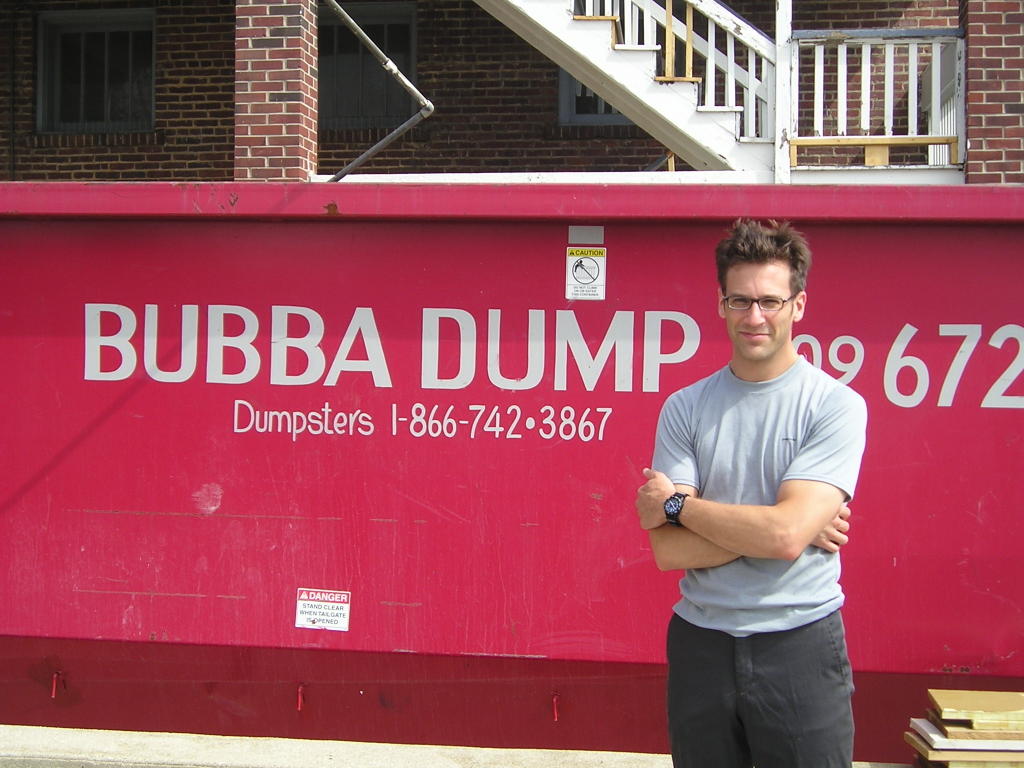
With what joy in my heart did I, having suffered the infernal heats and sweats of the Central Valley, crest the hills into Richmond and feel percuss upon my skin the healing, cool breezes and fogs of the SF bay, knowing that I would soon see Anna and Noah and our new home and all else full of promises rich and strange. Five days of nearly constant locomotion; even while I was asleep the road kept slipping under me. A lovely visit with GG in Normal, Illinois (see picture above). Gabe's still basically insane in his own special and inimitable way, so it's good to know that town's name has only served as an inducement to irony. Kansas, Kansas, etc. A place they call Denver; the high plains of Wyoming; the salt flats of Utah. Terrible twenty-car accident in the Great Basin of Nevada, the westbound lanes of I-80 become a helicopter landing pad for a good three hours. I've never seen anything like it, and I hope never to see such a thing again. There must be a way to transport goods that doesn't involve deadly behemoth tractor-trailers manned by underslept and probably malnourished people, given the food options on the road (burger after burger after burger). After that, I failed to cause any real substantial trouble in Reno. Not in the mood. But I did take a lovely little walk at Donner Summit the following day.
The truck arrives later this afternoon, and so, with my already ravaged body, I'll haul all of our things up into our new second-and-third-floor apartment at University Village in Albany. The townhouses there are surprisingly handsome, with lots of light and air, and a communal feeling--toys everywhere, friendly albeit exhausted looking student parents, joy-stricken children--that's probably rare these days. Smaller, of course, than our house in Ithaca, but many perquisites.
If you are alive mostly in the Bay Area and are reading this, please do let me know how I can find out about poetry readings. I'm eager to begin living here with my ears.
Monday, July 25, 2005
Driving x-country early tomorrow morning, going back to Cali' (after twelve years) so the blog will be down until the 1st of August at least. I plan to visit Gabe in Normal, IL. I've got Paradise Lost on the iPod, as well as newest Kazuo Ishiguro novel which, people tell me, is actually good. I'll let you know.
Saturday, July 23, 2005
Hmm. Since I've now heard this a few times, I suppose I should chime in vis-a-vis Tate and Young. In college, I worshipped these two guys, wanted to be them, read their books to tatters at the expense of other kinds of things I could have been reading. And perhaps for this reason, a personal reason, I can't really get into recent work by either one. Since The Worshipful Company of Fletchers, Tate seems on autopilot, virtually lobotomized-- a member not of the School of Quietude but as Jordan renames it, the School of Klonopin--and although I get that he's aiming for a it's-so-boring-and-dull-and-empty-it's-funny kind of humor, I ain't feeling it. Incidentally, I don't like most of Andy Kaufman either, so perhaps I lack the necessary brain centers for this kind of humor. With recent Young, I miss the ferocity and extemporaneity of Strike Anywhere, his ability to riff in wide orbits on the smallest and most petty and ridiculous of occasions. In all of his writing since, I get an eagerness to impress and a devicey, algorithmic goofiness. I do occasional find myself knocked down by a poem or two, but I feel sad, mostly, that he got so much attention for doing what comes so easily to him--goofing off in the back of the class. To my mind, Young's the class clown; Tate doesn't even show up to class. (When, as an undergraduate, I went, heart in hand, to petition to get into his workshop, he could only answer in two words: "Not possible.") If I had to choose, and I'd prefer not to, I'd take the early and middle Tate, from Oblivion Ha-Ha onto Fletchers--there's more punk-rock in Tate, more revisionary humor as opposed to humor about things we already find funny/annoying, more necessary and vital affront to what we expect(ed) from poetry. Young, on the other hand, seems to be operating within the bounds of a certain dignity and propriety. There may be more craft in Young, more verbal pizzazz and a more voracious imagination, but there's also that lemon-scent Pledge smell. Mary Ruefle, on the other hand, does everything Young does and more.
As for Vallejo, The Black Heralds has its brilliant moments--I enjoyed Eshelman's translation in the recent APR--but it's probably not the place to start. Read anything from Eshelman's translation of his posthumous poems "El hecho is que el llugar. . . (The fact is the place. . .") or "Nueve Monstruous" or anything in the immediate vicinity of these poems. "Tengo un miedo de ser. . . (I have a terrible fear . . ." [I don't have my book, so I may be misquoting.] Whenever I read these poems, I'm convinced that he's as good of a poet as they come--compassion, rage, dazzling intelligence--a completely original and oblique diction, corkscrew syntax, delicious exclamation points and too many dashes!--alternating between tortuous description and flat, plain declaration. He underwrites every bit of sentiment or directness that he conveys in those poems, emerging as it does out of the most gravelly, pixelated and visceral confusion. I find his lack of anxiety about big nouns--fear, time, love, desire and Co.-- refreshing.
Subscribe to:
Posts (Atom)