Showing posts with label Poetics. Show all posts

Saturday, August 11, 2007

I keep forgetting things. Along with Kasey's post, one of the things that got me going on this line of thought was the following quote from Jameson's afterword to the terrific Verso book Aesthetics and Politics (1977), a collection which has the salutary effect of leading one to recognize how many current arguments merely recapitulate those between Ernst Bloch/George Lukacs or Adorno/Benjamin in the context of early 20th-century modernism and the avant-garde:

For when modernism and its accompanying techniques of 'estrangement' have become the dominant style whereby the consumer is reconciled with capitalism, the habit of fragmentation itself needs to be 'estranged' and corrected by a more totalizing way viewing phenomena. In the unexpected denouement, it may be Lukacs--wrong as he was in the 1930s--who has some provisional last word for us today. Yet this particular Lukacs, if he be imaginable, would be one for whom the concept of realism has been rewritten in terms of the categories of History and Class Consciousness, in particular those of reification and totality. Unlike the more familiar concept of alienation, a process that pertains to activity and in particular to work (dissociating the worker from his labour, his product, his fellow workers and ultimately from very 'species being' itslef) reification is a a process that affects our cognitive relationship with the social totality. It is a disease of that mapping function whereby the individual subject projects and models his or her insertion into the collectivity." (212)

Many will, I'm sure, recognize how this early formulation presages his later work on postmodernism, not to mention his contentious reading of the status of the fragment in Bob Perelman, a reading which someone once dubbed (who was it?) "the primal scene of language poetry."

*

The link to the SPD page below was broken. It works now. And for some reason, my e-mail was not displaying in my blogger profile. But that's fixed now too, I think.

*

Also, how awesome is Stephen Rodefer's Four Lectures? Along with Harryette Mullen and the obvious ones like Shakespeare or Joyce, one of the best all-time punsmiths. (Sadly, I see that ECLIPSE has removed its pdf edition in advance of a reprint from Barque Press. I suspect that the availability of the former would diminish sales of the latter not at all, if it did not, in fact, increase them. What do others think?)

"Pass me a little of that petit pain."

Tuesday, August 07, 2007

Estrangement and Comfort

I'm a bit late on the uptake, but I wanted to note how useful I found this post, of Kasey's, about the constitutive tension between, on the hand, the negative, estranging (ostranenie or verfrumdungseffekt) aspects of contemporary poetry and, on the other, its will to presence or immediacy (projective or breath-based poetics, for instance). I do think that, in post-45 American poetry and poetics there is an unexamined conflict between a poetry of immanence and a poetry of artifice. Unexamined because, due to other similarities and values, writers who work one end or the other of this spectrum tend to get run together in the great hagiographical encyclopediae of our day. It's worth saying that an attention to these differences might--like Hejinian's sense of "experiment" as a relation to the real--allow for diagonals and diagnostics that cut across the quietude/new American binary.

But more importantly, the post makes me realize that I might not have expressed as well as I wanted to one of my points vis-a-vis Juliana Spahr's The Transformation. That is, I think that there's a kind of habituation curve to negativity in poetry, a process whereby the initially estranging or alienating technical effect--the fragment, for instance--becomes either strangely comforting or, alternately, gets so subsumed by mass culture, as to become somewhat toothless. The Dadason Avenue problem, we might call it. In such a moment, without an attempt at reinvention or an acknowledgment of the changed conditions, the mechanical continuance of such techniques becomes either amnesiac or cynical.

My sense is that Spahr understands her post-New American audience well enough, and is at least partly directed to that audience enough, that she realizes that a poetics of simplicity, referentiality, honesty, that at the same time continues to employ some of the stylistic markers of "fragmentation, quotation, disruption, disjunction, agrammatical syntax," will, in its own way, really fuck with people. She creates an especial estrangement for readers who have become habitutated to estrangement, readers for whom there has been a kind of ostranenie saturation. For example, in the aftermath of 9-11, while the characters in the book are in New York, Spahr notes this curious reversal with a tone of optimism: "And they began at this time to think of the poetry that used fragmentation, quotation, disruption, disjunction, agrammatical syntax, and so on not as a radical avant-garde break but as the warm hand of someone they loved stroking their head, helping them to relax the muscles in their head and inviting them to just close their eyes and relax for a a second with words of someone else. This feeling somewhat answered that constant question about the use of the avant-garde in a time like this" (188).

At first glance, I find this formulation completely inadequate, a sentimentalized notion that sells poetry short. And, of course, this is precisely what I'm supposed to feel. Indeed, by feeling that way, by attending to the balance of both estrangement and comfort within the book, I have fallen right into the trap-of-sorts that the book has laid for me. I do not think it is incorrect to assert that this is an extraordinarily strategic book, one that understands its readership well, and one that seeks to work with and against it. And it's precisely Spahr's acknowledgment of the conditions (embarrassing to many, I think) of her readership that allows her to do what she does. Has any poet ever so cannily worked the dialectic of comfort and estrangement? Maybe Stein's deterritorialization of the spaces of comfort and domesticity in Tender Buttons.

I use the word "canny" as my own strategic move, for I think that Spahr's work is quite close to Freud's essay on the uncanny. Both writers have a remarkable sense of the dialectic whereby the familiar (heimlich) is repressed and returns as something uncanny (unheimlich), but uncanny precisely because it retains elements of the familiar. You can see this dialectic at work in the changing political conditions of the move from Hawaii to New York that I mentioned in the earlier post. It's worth saying that this is the kind of effect that those whose accounts of poetry are entirely technical or impressionistic (which is, to say, 4/5 of all poetry reviews) will never take the measure of.

While I do hesitate to open a can of assvagina in a studiedly neutral post, this may be the key to the work that elements of the "cute" do in some Flarf, where, amidst all of the estranging verbiage and allusional range, the cute serves the same purpose as the familiar/comforting does above. For a brilliant reading of this exact issue, check out Sianne Ngai's essay "The Cuteness of the Avant-Garde." (If you have no JSTOR access and want to read it, e-mail for a pdf). I love to steal from the institutions of High Theory! Death of the author, put your money where your mouth is!

Tuesday, July 24, 2007

The Transformation

Perhaps because I am easily fatigued and often fatuous, I like the word indefatigable, its too-many syllables beaded along a quick, trochaic string. I also like Juliana Spahr’s new book, The Transformation, an indefatigable memoir-of-sorts, although the term memoir fits this work about as well as it does A la recherche du temps perdu.

There is a remarkable patience to this book, a perseverance rare in this age of point-and-click blandishments. And yet, how different her indefatigableness is from its modernist predecessors: Beckett’s “I can’t go on, I’ll go on,” for instance, or Stein’s steadying, spreading repetitions. This is not the indefatigableness that Sianne Ngai incisively dubs “stuplimity.” Not a tirelessness that assaults, that tires her out, as a fisherman might reel in a swordfish and let it dive hundreds of feet, reel it in and let it dive, until it can dive no more and is hauled onto the deck of the ship and clubbed to death. This book is not like that.

As much as The Transformation displays many of the markers of this tradition, style here is not necessarily a form of resistance, not a way of enforcing the art object’s autonomy. Rather, it’s a way of not foreclosing thought (Lyn’s resistance to closure), of not prematurely deciding. I can think of no other work right now that displays the same patience in exhaustively detailing the million political ambivalences that ramify around even the smallest action, nor can I think of one that does a better job of detaching ambivalence (or “negative capability”) from a kind of quietism. Nor can I recall a work that is as untiring in greeting each political situation with a willingness to rethink even the most foundational of presupposition. That’s to say, I’m embarrassed by how unembarrassed this book is.

Lately, there have been many thinkers on the left who like to, umm, talk shit about relativism, which also usually involves a critique of identity-politics and multiculturalism. Some of these critiques are subtle and interesting—Alain Badiou’s, for instance—and some are plainly the idiotic result of that conservative psychosis (Hitchensitis, Lyotarditis) that often afflicts writers on the left who don’t, like, take a chill-pill every once in a while: Walter Benn Michaels, for instance, whose factota are even known to haunt the comments-field of Ron Silliman’s blog. As I often feel with good writing, Spahr’s book, resistant as it is to “theory,” provides a useful counter to these positions, reminding me that Marxism was, first of all, a form of relativism, one that tied the things that could and would be thought to the relative positions and practices of the thinkers within the absolute but perhaps also ineffable field of history. And so, in The Transformation, the contradictions that must be enumerated and the political positions—nationalism, for instance—that must be countenanced and lent support in Hawaii, are precisely the positions that must be rethought in post-911 New York. Each situation requires its own ethos, its own particular mode of responding.

Despite or maybe because of its contraindication here, and following some of the discussion on Josh's blog about aesthetics and ethics, I’m reminded of Badiou’s own notion (in Ethics: an Essay on the Understanding of Evil) of a non-normative ethics (and hence, a kind of anti-ethics in his definition)—that is, an ethics not based upon norms or protocols but one where, in the aftermath of a significant “event,” certain resistant forms of relating stabilize and come into being, certain individual and collective subjects to which anyone can claim allegiance. Ethics, in this formulation, involves remaining faithful to these subjects in a positive, affirmative manner. The only thing that is un-ethical in such a situation is either, on the one hand, losing faith when it is still possible to continue under the aegis of the event or, on the other hand, trying to force such inter-relationships through norms and protocols rather than through voluntaristic allegiance.


In Spahr’s book, there are, broadly, three such events: the advent of her love relationship with two other people (and the triangle’s “indefatigable” self-affirmation in the face of others’ bafflement); the U.S. colonization of Hawaii, and the resistance that it requires or makes possible; and the attacks of 9/11 which, as we know, reshuffle existing political formulations and require for the left a deep reconsideration of its political strategies.

The triangular relationship, which is the center of the book, and carries over from the second situation to the third, forms a kind of model for this ethics, I think. A form of ambivalence—a both-meaning—that precisely doesn’t mean lacking conviction or lacking the will to act. If it is an ethics, it is not one that sets down norms, rules or procedures but rather that seeks to find ways that one might persevere within a particular situation. In this it’s a powerful and moving model of the kinds of open-ended vigilance and fortitude that the present state of the disaster requires.

*

Speaking of which, if you haven’t read already, do look at this disturbing summary of the conclusions drawn from The Nation’s extensive interviews with current and former Iraq War soldiers. That the American occupation involves the continuous, ubiquitous killing, maiming and humiliating of millions of Iraqis will no doubt not surprise most of my readers, but it’s probably some of the best evidence of the extent and progressive worsening of these atrocities. A good thing to point to if you’re in conversation with someone who wants to claim that such events are rare—that is, someone who only reads mainstream new sources.

Needless to say, another reason we shouldn’t need for an immediate withdrawal and not the absurd troop-reduction-and-extensive-bombing plan we would likely get with Colonels Clinton and Obama (both of whom just signed off on an attack on Iran last week). Here’s hoping a real anti-war movement manifests.

Monday, July 02, 2007

Coolidge, Lowell and the Photo Poem

I can’t shake the idea that Clark Coolidge’s Own Face, the first book from his so-called autobiographical turn, is to some degree an explicit attempt at an experimentalist’s version of the confessional poem. The whole book seems to reverberate with echoes of Robert Lowell.

I am not saying, of course, that the reflexive distinctions we might generate here—experimental vs. confessional—won’t largely hold; but it’s worth considering, if only to irritate those who like their distinctions clean-edged, that there are a number of similarities between Coolidge and Lowell. First off, both are pessimists (or, as the case may be, realists) who situate their poems amidst a culture in decline, post-industrial tableaux of rusting, abandoned factories, quarries and broken concrete structures. I’d even say that both flirt, at times, with a kind of nihilism. And, furthermore, their diction choices and rhythms (quite apart from the very different phrasal and grammatical arrangements) are strikingly similar: heavily Anglo-Saxon, long on consonants and consonance, pulsatile. Perhaps, the common point of departure here is Melville.

Coolidge:

. . . Later I reel
in a yell as my cousin takes a bite from my shank
beneath ranchhouse breezy curtains of Marion. On a trudge up
from the gasoline rockpit in the gaze of Judy Lamb,
she carries my pack, my jeans rolled as I step on
pipe. . .

[“Album—a Runthru”]

Lowell:

I picked with a clean finger nail at the blue anchor
on my sailor blouse washed white as a spinnaker.
What in the world was I wishing?
. . . A sail-colored horse browsing in the bullrushes. . .

[“My Last Afternoon with Uncle Devereux Winslow,” ellipses Lowell’s]

Indeed, although I don’t think I’d stake any kind of argument on this— (consider this a series of provisional mental sallies)—without a bit more to go on, there are at least two moments in Own Face that sound like explicit Lowell quotations. For instance, Coolidge’s “a burst the cleat of harp / mark vine wild to hog hill red fox Morman behind the Hilton. . .” seems to invoke Lowell’s brimming iambic line “A red fox stain covers Blue Hill” from his super-famous “Skunk Hour.” Of the same poem, compare these two stanzas:

One round night, I’ll term it that pulling
some depth on my cube. Far from starring the black
books holding meat, the babies that plow
down the chute, unable to grasp still
starring. Not apt to finish I’ll fix the sun
on lock. Then walk down the stairs
in the woods under lights.

[“The New Look Sways”]

------------------

One dark night,
my Tudor Ford climbed the hill’s skull;
I watched for love-cars. Lights turned down,
they lay together, hull to hull,
where the graveyard shelves on the town. . .
My mind’s not right.

Perhaps the title of Coolidge’s poem is meant to recall Frank O'Hara's comment about “Skunk Hour”, one that for all its drollery, doesn’t, in its revealingly genteel sense of decorum, actually do much to distinguish O’Hara’s “I do this, I do that” from Lowell’s “I myself am hell.” The quote: “I don’t think that anyone has to get themselves to go and watch lovers in a parking lot necking in order to write a poem, and I don’t see why it’s admirable if they feel guilty about it. They should feel guilty. Why are they snooping?” If it is a poem about prohibited gazes, then Coolidge’s “black books holding meat” does much to physicalize the halo of shame which rings the voyeur’s object of desire.

The condition of the gaze, then, is where the two poets part ways. Both of them figure the poem, and the collection of poems, as photo and photo-album. But their takes on the enduring presence of the past, its accessibility or lack thereof, diverge sharply. For Lowell’s Life Studies, the dominant metaphor for memory is travel. The gaze slides into the past like a train crossing the Alps (“Beyond the Alps”) or a boat returning from Europe across the Atlantic (“Sailing Home from Rapallo”). Coolidge’s past is geological, not a destination to which one must travel, but an ossuary which one must sift through, a ruins, a geological record that only exertive, even exhaustive, labor will recover. Time in Lowell is transparent, extensive and empty. In Coolidge, it’s opaque, accretive, and intensive.

Still, despite these differences, the tone and stance of both poets, looking at an empire in decline, a senescent culture, the renewals of which are merely disguised ruination, is basically the same. Emptiness-meaningless and opacity-meaninglessness give way to the same sense of irreversible entropy (a metaphor that both poets find recourse to). In the end, though, Coolidge may have more of a future than Lowell (and I say this as somebody who thinks Lowell is an important and, among many of the poets I know and read, underread poet). His punning sense of the photo-album as a musical album, a "record" that can be played or even “covered,” that is performed may model a more active, less contemplative to our national ruination. This will constitute my only remarks about the day of singed flesh and gunpowder known as the 4th of July.


[*Funny that Kasey wrote something about Coolidge just yesterday, and with a similar polemical drift.]

Wednesday, May 30, 2007

The Line


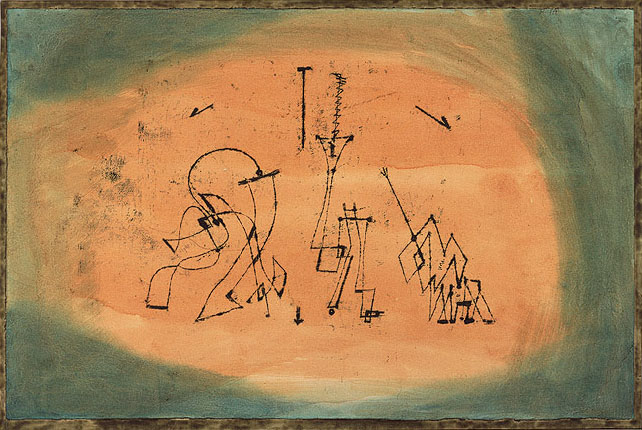
[Paul Klee, Abstract Trio, 1923, watercolor and ink on paper]

About Jennifer Moxley's lovely new book of prose poems,
The Line, I have, on more than one occasion, heard smart friends express reluctance about what seemed to them an easy or flip opposition of prose and verse, coming as it does immediately within the most perfunctory of descriptions of the book (title, genre). While I'll admit that this opposition might initially seem like a joke or a gimmick, I'd argue that the kind of reflection it affords is deeply moving and, by the end of the book, complex without the least hint of stale paradox.

This is partly because the poems outmaneuver any expectation that the work will be a kind of poetics, reflecting on its methods and on the relationship between prose poetry and Moxley's customary intricate and musical lines. Instead, at the beginning of the book, "line" as theme addresses itself to an experience of division, separateness and segmentation on multiple levels: first, the division of the present, a kind of moving wall, or line, between the past and future; second, the line that separates waking from sleep and marks the interpenetration of these two states; and third, the ethical line--that between thinking and acting--which Moxley's poetry has always agonized over, and which she has always seemed to suggest is poetry's special agony. For Hegel and for post-Hegelian philosopher like
Lukács, art is that which can delineate or clarify the result of capitalism's division of labor, a fragmentation of human activity and society into separate spheres--contemplation here and action there; aesthetic appreciation of form here and practical considerations over there. Art does this because--in making, in poiesis--form can never be separated from some attention to materials. Of course, the repair to these fractures that art provides is only virtual, and only a certain kind of praxis (that is, for Lukács, a revolutionary praxis) can truly heal the split. But in attempting to fill the gap, art measures its shape. As with deconstruction's logic of the supplement, it's a add-on that reveals the incompleteness of the thing added to. Those familiar with Moxley's work will recognize that the fractures and displacments of everyday life--and of aesthetic practice in everyday life-- are of major concern to her. She seems to be someone for from whom the question "what is poetry for?" can't really be banished. Many poets, it seems, just stop asking themselves this question, or at least don't voice it out loud. But if you read her interview Daniel Bouchard in the recent issue of the Poker, you'll notice her musing on it in all sorts of different ways. It's only in the final few poems from the book, then, that "the line" really becomes self-referential or a meditation on poetic form, and by this time it's been so thoroughly colored by these other considerations that these references refuse to be taken as simple aesthetic positions. Nevertheless, as much as I would be irritated by a book of poems that was suffocatingly self-reflexive, I would also not enjoy a book that didn't, in one some sense, make style one of the ways it thinks, and of course Moxley does this. That is, in place of the break that we get in a lineated poem, here instead we have a kind of moment of unconsciousness that snakes its way through the space between the final period and the first letter of each sentence. Although the poems put more emphasis on paradigmatic coherence between certain sentences than most exemplars of "the new sentence," nevertheless I can't but feel, often, that there's been a slight sub-perceptible displacement in between sentences, a cut too quick to notice:

Mystical Union

Infused with an early century's fatigue you dream you can never wake up. Your thought, a small dot on the horizon, is overtaken by traffic. Huge semis whiz by issuing noxious black smoke. Are they pushing the world's cheap goods onto the local market? Everything's plastic and bright. Mimics of vulgar joy, the people refuse their misery. In between moments of stupor they awkwardly waddle forward. Are they to blame? You dream the end of life has been forsaken by a world in ruins. Someone performs an amputation to tie the resources up. Your children are threatened not by a system but by a single unethical man. The air shimmers. You step off the curb into nothingness where the line offers itself to your hands. Grab hold or fall. Happy in the thought you might never recover you consign your trust to this flimsy thread that nobody else can see.
What I mean, I suppose, is that, for the most part, I get the sense that I can track the transitions here, that I can paraphrase to myself the latent dream-thoughts (these are all, or mostly, dream poems). I've often felt that many transcribed dreams fail as interesting writing to the extent that they succeed in being interesting dreams. Perhaps, in some sense, this is due to the fact that, as writing, they bring entirely to the surface all of the things which are often latent--below the line-- in dreams. They blur or erase the line. Freud, for instance, realizes that the associations generated in the transcription of the dream are as important as the transcribed material itself. Where dream writing is dull, or simply strange in a banal ways, is where it opts for a literal transcription of the dream instead of a production of the dream. The line, in the poem above, as an undisclosed and undisclosable technique of choice, is the way to make a kind of second dream--called waking, perhaps--from within the space of the first dream. It's an active dreaming, rather than a passive, one. Instead of accepting the fragmentation of experience into separate units which a latent logic will make sense of, the poem tries to transcend these divisions actively, even as much as it realizes that this transcendence is, well, mystical and perhaps mystificatory: like the solution of blaming a "single unethical man" (our president, for instance) instead of the system itself. As with the discussion about art in general in the above paragraph, the attempt to transcend these divisions is what, ultimately, clarifies them. Prose, in this sense, represents the unformed experience that the principle of choice has to cut into and through: where "the end of life"--the point, or the period--"has been forsaken by a world in ruins." By calling the book The Line, Moxley suggests that prose here is, in fact, lineated. It is lineated poetry degree-zero, where the possibilities for lineated shape-making (not, of course, the only kind of shape-making) out of those ruins present themselves all at once, and where the speaker hesitates among those possibilities. In presenting dream-logic and thought-logic and writing-logic, we get, perhaps, something like Moxely's lineated poems in embryonic form: prose poem as pre-poem. Last month, somebody, having been told that I was a difficult person, wrote to see if I'd participate in an AWP panel on difficulty. I'd just read this book and suggested that I say something about it, not because I think it's a particularly difficult, unforgiving, brutal or forbidding poetry (qualities I often like in a poem). On the contrary, I find Moxley's late-Victorian sentences leisurely, hypnotic, soothing, even if I do have to go back and reread the poems. No, I thought about talking on this book because I think it's a kind of meditation on the place of poetic difficulty, and more generally, about facing non-writing difficulties in writing.
The Atrophy of Private Life

In the heavy fashion magazines strewn here and there around the house the photos of objects and people mouth the word "money," but you, assuming no one wants you anymore, mishear the message as "meaning." Arousal follows. The lives of the rich are so fabulous! The destruction of the poetical lies heavily on their hands, as on their swollen notion that we are always watching. There is nothing behind the mask. Nothing suffocating under its pressure, no human essence trying to get out.
Awareness, always awareness. Don't you see how these elaborate masks are turning you into a zombie? The private life is not for they eye but for the endless interior. It is trying to push all this crap aside and find the missing line. Nobody, least of all the future, cares about the outcome of this quest.
It is easy to lose, through meddling or neglect, an entire aspect of existence. And sometimes, to cultivate a single new thought, you need not only silence but an entirely new life.

The New Constant

Failed things. What was once aesthetic pleasure is now practical satisfaction. What was once difficult to comprehend is now a necessary thread. The present turns into feathers, light and grey, and scatters with the slightest purposeful breath. Awakened, mono-vocal, redirected. The evolution of evasion in the move from charming to rude. Neither blame nor repercussion. With deathbed pressure the everyday keeps memory as a form of compassion, the future as unexplored utterance. Between these two perspectives the line continues to run through your dreams which, no longer a lost reality, work to triple interpretable being. The sacrifice of the new life has reanimated the birds. Their song is your troubled lover. This is the house where you live now.
Is it right to say that Moxley confronts a world in which the formal and stylistic devices many have come to associate with poetry in 20th century, difficulty-making devices, have lost some of their edge, some of their critical power? I think so. By stripping all of those markers from the poem, instead she seems to allow herself the license to confront the difficulties of matter, of dailiness, where form threatens threatens a hardening habit, rather than the construction of new expressive possibilities. As beloved as she may be to writers in the tradition of the New Americans and fellow travelers, she resembles that poetry surprisingly little, I'd say. If there are strong influences here, I'd say they are in Victorian prose, and more strongly, in late 19th-century French poetry, both moments of cultural and political exhaustion marked by vigorous attempts to break with the past. Gramsci: "the crisis consists precisely in the fact that the old is dying and the new cannot be born." Not exactly, quite, or yet.

Friday, March 30, 2007

Is Vagueness a Style?

I've been following with interest the discussions (now finished, I'm late) about the teaching of creative writing, and thinking in particular about Reginald's remark, and Joshua's and Kasey's response, that "vagueness is not a style."

At the risk of sounding like a creative writing student in one of Reginald's class-- (well, I once was)--I must say that I'm not at all sure that I can maintain--as he does-- a meaningful distinction between vagueness and ambiguity (two forms of abstraction, it seems to me), even if I can understand why one would want this kind of distinction.

There is vagueness that I dislike and vagueness that I like, vagueness, that is, which I find "meaningful," ripe with possibilities, experiences,"expressive," with room for thinking and feeling, that I sometimes might dub with the valorizing new critical term "ambiguity." While I find the Eliot quote about free verse, and, more generally, the inescapability of form, an important observation, I often feel that the way this kind of claim gets used, true as it may be in the long run, might encourage a kind of complacency as regards given forms and the urge to escape them (no doubt, this is far from Eliot's intention in the essay). Beckett may have ultimately found only another type of style instead of stylessness, but the fact that he tried "écrire sans style," in a second language, is important. Too often, the Eliot quote is used to discourage such attempts, rather than to describe their impossibility (which was his original intention, I think).

(Tone is, of course, everything here, as is keeping in mind that reader's concepts, teacher's concepts, writer's concepts, and critic's concepts, while full of overlap, don't always translate. They are different discourses, structured by different social relations, and in that each of these things might ask for different things from poetry).

But back to the original discussion: the difference between vagueness and ambiguity, two forms of abstraction that are, respectively, "discouraged" and "encouraged" by many people involved with poetry, lies in that verb "tried" that I used to describe Beckett This is where the distinction originates, in my view--in a pesky notion of authorial intention. However tattered my copy of On Grammatology or Philosophical Investigations, however many times I've read Barthes and Dickinson and Foucault and DeMan on notions of authorship, if I say that something is ambiguous I probably mean that the abstraction seems willed, intentional, purposeful, calculated, meant; vagueness, on the other hand, when it's used as a pejorative, will seem like an accident, a mistake. To the extent that "vagueness" is a style it is an intentional mistake, "kind of accidentally on purpose" as Walter Neff puts it in Double Indemnity (B-11). Am I agreeing with Reginald or not? I don't know. Perhaps I'm being "purposefully" vague, (er, ambiguous). Perhaps I just said that to get out of trouble, backloading intent. Personality as plug-in.

If vagueness is a style, and I think it is, isn't one of its names "John Ashbery?"Ashbery, that "mainstream unto himself" (as a friend has called him), whose advice to his own creative writing students, recorded in the poems from Houseboat Days, was as follows:

. . .Now one must
Find a few important words, and a lot of low-keyed
Dull-sounding ones.


Indeed, Ashbery's middle-period poems, from, say, Self-Portrait to A Wave often proceed from vagueness and emptiness toward a kind of specifity which they then evacuate in a final gesture of setting off again:

"The extreme austerity of an almost empty mind
Colliding with lush, Rousseau-like foliage of its desire to communicate
Something between breaths, if only for the sake
Of others and their desire to understand you and desert you
For other centers of communication, so that understanding
May begin, and in doing so be undone."

This intentional vagueness, which occasionally becomes (especially in Ashbery's imitators) a didactic, even moralizing vagueness, didn't start with Ashbery. It also goes by the name of Gertrude Stein and Wallace Stevens. Vagueness is what haunts Stevens dictum about the poem, that "it must be abstract." It is behind Stein's choice of a vocabulary no larger, often, than that of a third grader's, in order that she might reveal the structures of cognition, rhetoric and grammar that underlid and define the way that we talk and think and write. It is for love of vagueness that Stein turns from nouns; it is what makes her prefer words like "the" and "a" and "as."

As with Geoffrey's book, the choice of purposeful vagueness, flatness, abstraction might mean a refusal of the division of labor, of the law that says, "be specific! Do this thing and not that thing! Pick a historical field, a genre, a subject, a medium! Stay within the discourse! Ground yourself in your predecessors, in origins!" It might mean a refusal of these kinds of identities. Or, alternately, it could mean a submission to the laws of exchange and abstraction which wants our discourse as bland and fungible and interchangeable as possible, so that the speech of one group is abstract and contentless enough that it can be fitted to the speech of another, etc., etc.

So I run into a problem here. My descriptions--vagueness-- of what I value in a certain poet could equally be descriptions of what I detest in another--vagueness. Vagueness is both too vague and yet again not vague enough, and so I have to come back to tone, to relationality, placement, the fact that there may be very little inherent in a certain device that can make it aesthetically effective or ineffective. And I'm back, too, to notions of intention, which I can escape, probably, only by positing other kinds of agency: history, hegemony, the unconscious, power, discourse, language, etc.--all of the things that might speak through writing that is "purposefully vague." I'm not sure I can get away from these bewitchments, problematic as they may be. But what I can do is to keep reminding myself of the wish to perform these operations on texts.

Another example of effective vagueness, of the "new vague" (le flou nouveau?) and its refusal of specifity and specialization and identity, can be found in Juliana Spahr's Response (.PDF). Indeed, all of Spahr's books are lessons in the use and misuse of vagueness and the kinds of political and aesthetic knowledge they can deliver:


realism’s authenticities are not the question

the question [role of art in the State]

we know art is fundamental to the [New State] as is evidenced in village scenes,
majestic ancient views, masses and masses of [generic human figures]
marching in columns, swords coded as plowshares, image as spectacle

we know [name of city], [adjective], [name of major composer]
to recode [reduce] it: Linz, ambiguous, Wagner

we know a [name of major historical figure] calls, authentically, for a more total,
more radical war than we can even dream in the language of the avant

garde

we know a commercial promises to reduce plaque more effectively in this same
tone

but sometimes we exceed even our own expectations to surprise even ourselves

something encloses the impossible in a fable

an unreal world called real because it is so heavily metaphoric

we can’t keep our fingers of connection out of it
[from "Responding"]

I find this excerpt remarkably moving, as I find so much of Spahr's work, moving in the way that it seeks to uncover existing structures or systemic forces and find in them the kind of commonalities--destructive or constructive-- that they might allow.

Or, to use an example from a poet who plays a different role in the poetry world, one might think of Jorie Graham's use of the blank in The End of Beauty as a vagueness effect. No doubt, I'm missing numerous examples of effective or potent vagueness, but I'm sure you get my point.

--------------------------
Addendum:


I say all this while fully accepting, not so needless to say, the claims of specificity in poetry, of the material, the concrete, and its ability to resist the liquidation of the senses, the attentionlessness that seems to be, at least speaking for myself, the fate of my more and more mediated and virtual and bloggy life. I don't think I write good vague, and I wouldn't be surprised if I never manage to do so. There are other kinds of poetry out there.

Reginald's poetry, especially his new book Fata Morgana, is certainly concerned with making worlds from concrete colors and textures and details, concerned with preserving specifics against their misuse. But it also displays a tricky and ambivalent relationship to the vague, to the terrain vague in which the fata morgana of the title throws up its apparitions and mirages. At the risk of overworking the above formulations, I'm curious about the book's persistent attraction to spaces of openness, plainness and emptiness (spaces of, dare I say, vagueness?). This is pretty much, as it seems to me, the scene of writing here--a generative expanse, often described as a visual field, which seems to reinforce the incompleteness of the speaker, driven out of himself by lack and desire. One of the other names, too, for lack, in this book, is the gods, figures it seems for the world's disenchantment, its exposure:

But the Sahara isn't all sand
bare-scrubbed plains, barren
soil, thorn, broken stone,
gravel shimmering ocher and dun

Dunes the color of honey, wind sculpted
ruffles and flutes, a knife edge to leeward,
a hundred feet high
Tied dunes, echo dunes, barchans, seifs
parabolic blowout dunes, tranverse dunes, sigmoidal
dunes, sand seas' shifting shapes
(quartz ground fine as flour, powdered sugar)

["My Desert"]

*

Distance is money just out of reach,
a kindness like rain-laden clouds
that never drops its coins. Epochs
of fossilized trees crawl rusting hillside
strata: they smell like somewhere else
I've never been, an Anatolia
just outside the mind. Geometries
of travel and desire (from here to want
and back again), the myths of pleasure
reinvent another ancient world: oiled boys
racing naked around the circular walls
of Troy to find out who will wear
the plaited wreath, parade painted circuits
of unburnt parapets waving
to the crowds.

("Homeric Interim")

Vague space is what allows, it seems, for virtuousic reflection, meditation, for gorgeous spills and tumbles of detail. It's important to note, of course, that the poems are only vague at one level of their content, vague at the level of referent, but hyperspecific at the level of the sign. In this, they are the opposite of, say, Spahr's poems.

If there is anything that's vague at the level of the writing in Reginald's book it is probably the curious and charming presence--as a kind of internal voice, sometimes allegorized as "song"--of pop lyrics, whose cliches seem to push the poem forward to some kind of specifying concretion:

Song keeps repeating


shit where you eat, don't shit
where you eat. The day
begins with burning, then remembers
to wake up: sweetbitter resins,
pollens, dripping cum smells
flower, white. Highway's haunted
by rememberd men and boys, no light
but passing pickup trucks.

("At Weep")

What am I getting at here? Well, I suppose I'm trying to imply that form solidifying from a vague content, and vagueness deforming specific content, are in tension across these different poems by very different poets. Each strategy might need the other as a precondition, as the material or scene for its own work.

Wednesday, March 14, 2007

Free! Indirect Discourse!

In the hope that there are interested readers and respondents, I'm making available an essay which imagines an encounter between the opposed aesthetic stances of Frank O'Hara and Theodor Adorno; that is, two thinkers whose moving and persuasive accounts of art have been absolutely indispensable to me, and who seem irreconcilable.

I wrote this essay with contemporary poets and contemporary poetry in mind (that is, I wrote it while thinking about you, about the claims of the recent past on you). In rough paraphrase, the essay theorizes forms of resistance and autonomy that do not depend upon negation and oppositionality as Adorno conceives it ( à la Beckett), and that do not require the kind of autonomy from the "culture industry" that may no longer be possible. It's a tendentious essay, purposefully so, and I welcome all forms of (civil) response to it. If there is interest in this piece, I will share other essays--on Bernadette Mayer and Vito Acconci, on Jeff Wall (just in time for his retrospective), and on Juliana Spahr and exception theory.

Having a Coke with Adorno and O'Hara (pdf)

Saturday, March 03, 2007

Green and Gray

I can't really think of any books--recent books, that is--that are doing what Geoffrey G. O'Brien's Green and Gray, is doing. (One of my favorite poems is here, others are here and here). Perhaps the thematics and thought-structure recalls the Frencher side of meditiative-speculative poetry in the last twenty years--Rosmarie Waldrop, Michael Palmer and Norma Cole. He might be a tonalist.

But there's such a relentless refusal of particulars, of the soft law of detail and concretion ("show don't tell" in workshop-ese) in Geoffrey's book, a refusal enabled, I think, by the fact that the poems insist on remaining lyrics written in something that hovers close, often, to blank verse. They insist on--and consist of, and insist in--the line as a kind of untransgressable boundary, strengthened the more that they push up against it with puns and rhymes and syntactical prestidigitation. Line as a mobius strip that enforces a forgetting of its own past, a smudged present part not-yet and part already.


I have forgotten what
would travel from the north
as a series seen from above
or from below, and the followers,
the flowers, I tore them up
the next summer, or rather
before or immediately after
and thought no more about it. ("Three Seasons")

I'm already screwing up the end of the poem
with a hopeful form of forgetfulness.
Let me confess to you that I plan a perfect poem,
one written during the historical period.
Now this was a period I don't remember
and now another is coming to meet it.
This may fuck up the perfect poem
I admit I'd already planned a kind of mass for. ("The Nature of Encounters")

Each kick-turn, then, involves both a (necessary, involuntary) forgetting of its origin and an attempt to ward off an ever-imminent ending, here the period to the couplets that keeps dislocating the poem (pushing it forward or back) and keeping it from being equal to itself.

Over the course of the book, if you read it in one or two sittings, the adventure of the line-as-phenomenon/line-as-subject leaves in the mind an image of what form is and what it can be--a way of resisting the dislocations of time. I keep thinking of Marcel Broodthaers rewriting of Mallarme's "Un Coup de Dés" as a utter visuality, as form whose content is form.


It is tempting, I suppose, to read form-as-content in Geoffrey's book, its intense abstraction ("remorse of the senses") as a critique of the increasing homogeneity and contentlessness of American life, where opposition is, in fact, turned to a curious kind of affirmation, activism become passivism; where dissent is neutralized into some pale form of civility, and the cherished freedom and choicefulness of the U.S. middle-class has no relationship to matter. This is a correct reading of the book, and a helpful one. But I wouldn't want to miss the work's deep positivity, its participation in the experimental project I mention in the last post. It is not only a critique of life-made-abstract, of sameness, but an attempt to use these things as methods that can prevail against them as lived. In reading recently for a working-group meeting on Marx and Darwin, I was pointed to these sentences from the first preface to Capital:


Nevertheless the human mind has sought in vain for more than 2,000 years to get to the bottom of it, while on the other hand there has been at least anapproximation to a successful analysis of forms which are much richer in content and more complex. Why? Because the complete body is easier to study than its cells. Moreover, in the analyiss of economic forms neither microscopes nor chemical reagents are of assistance. The power of abstraction must replace both.But for the bourgeois society, the commodity-form of the product of labor, or the value-form of the commodity, is the economic cell-form.


I think this is a fantastic account of the power of abstraction to work against abstraction, to find forms of concretion and difference and particularity that are not false or chimerical. Just as for Deleuze, whose empiricism is similar to Marx's, repetition of the same, repetition as a stutter, demonstrates the baseline difference that cannot be submitted to claims of identity--"differnece without concept"--in Green and Gray, Geoffey dresses his poems in a camouflage of non-particulars, somnambulance and hypno-melancholy, submits the poems to line's repetition-without-concept to reveal the sub-perceptible differences and particulars to which we might attend:

The experience of leaving
one category for another,
of smooth being colder
than rough and of
that December I suffer
as the experience of leaving
one category for another,
using a life that way
that opens and stops
moving, done,
furtively waving
as with one month
that opens and stops
among the others. . . ("Mixed Mode")

This isn't really the abstraction of, say, Wallace Stevens' "The Snow Man," described recently by an interlocutor as " the individual subject purging itself of material determinations." The purge happened long ago. Instead, Geoffrey works to drive abstraction to its breaking point. Coming a few poems away from the end of the book, the repetition above, the little stutter, could be read as a kind of pivot, the book having hit a kind of zero-degree of abstraction-contra-abstraction, and finally giving way to the new, refreshed particularity I'm suggesting is its end. The penultimate poem, "Hysteron Proteron," allows itself the enormous conceit of containing "examples of all that has happened" and goes on to index various events political, personal and literary. The first time I read the book, I objected to this poem as the book's end; after a run of poems which so steadfastly refuse proper names and the like, to come across "Paris" and "911 is a joke" truly threw me. Now, though, I guess I'm pretty convinced that this is the point. Though I'm still not sure that the close of the book completely succeeds at what I'm reading it as attempting (a turn to particularity after the suicide of identity, the suicide of the same) I'm also not sure what such a success would look like in this instance. Only Beckett, it seems now, has pulled this off, if anybody has. And in any case, if the exit arc comes too little and too late, then perhaps what it does is point us to the next book.

For those who are skimming, the point is that you should get this book. I look forward to hearing what people have to say about it, and about my reading of it.

Wednesday, February 21, 2007

Terms of Agreement

While I was away reading lots of Milton and Jacques Lacan and Ezra Pound and other things that footnotes are for and that require a certain rare mineral found in the bonedust of zombie scholars, a few blog-versations caught my eye.

It's true, I think, that the terminology for contemporary poetry we have now is inadequate, and that many are forced to rely on school-names (NYS, Language) and loaded binarizations (x vs. y) or binarizations with a mediating third term (the post-avant, the fence) for things that have evolved and proliferated in excess of these terms, and that were perhaps always less clearly marked (inside and outside poems) than people might be led to believe. I find all of these schemes inadequate, and no doubt there's always going to be some remainder in any attempt to map what people are doing. Good that.

But I also don't think it's exactly helpful to forego generalizing distincitions altogether; because what we're left with then is individuals or small groups of poets existing in a vacuum, social relations turned to objects, objects turned to -jects pro- and sub- and ab- and -e. The usefulness of generalizations--despite the violence they do, all categories are violent--is that they continually remind us of the social ground of poetry, at the same time manifesting important difference in the kinds of things that are getting written, and that get obscured by accounts interested in making all of the branches of the barred American tree root arboresce into the yes/no switch of ye olde blog. Good criticism can do this with or without a catchphrase, but not everybody will be able to produce good criticism on the spot (more on this later perhaps). So I think we need TERMS, MaSTERless and MiSTERless, MySTERious terms. What I want is something that is more descriptive than evaluative, that carries the grain and hue of a good, infrequently encountered or repurposedadjective, that don't aim to brick a wall right through the middle of poetry. I'd like clusters of terms like this, shots fired into the crowd, constellations or distillations or exhalations, clusters of terms that, in their proliferates, escape the vicissitudes of mirror-games (2), triangulization (3), gridlock (4), overkill (5) [see Kasey for an excellent discussion of these problems]. Josh's use of "neo-baroque," for instance, and related musings on "strategies of excess" seems likely to be productive--even if there is, or perhaps because there is, strong disagreement about what or who or why and wherefor this means.

Obviously, the more these terms seek to be total rather than to manifest a few neglected features, the more useless and confining and irritating they will be. The totals are elsewhere, like life.

I've said before why I think the term "avant-garde" implies certain notions of futurity, of forwardness, of being ahead-of-one's-time, that don't really match with my reading of the contemporary poetry that gets labeled this way. It also carries, alongside its military origins, connotations of intellectual collectivity, collective means of production and distribution. To be avant-garde, I think, requires existing within a cultural dominant that despises, ignores and continually misunderstands what you do, and that requires, as such, alternative means of making and distributing. That's to say, the term bears on the way poetry is published, read, shared, critiqued, the goals it sets for itself. By these two standards, there are many writers and collections of writers today where this term probably fits, to some degree. But there are many that are not. Get to work: you're falling behind the average person on the Bergdorf alienation scale; you're not pissing enough people off. Even you, Behrle©.

I would be less reluctant to use it in this manner if other people used it this way too. But they don't; it means the same thing that "indie rock" does in music, or "independent film." Very little. So I just can't recommend it as a productive term for contemporary poetry. It's still fine for the most of the stuff it gets applied to historically.

I do, however, really like Lyn Hejinian's very specific definition of experiment and experimental in the first of her "Two Stein Talks" and pretty much throughout her collection The Language of Inquiry, the title of which shows her commitment to epistemological and phenomenological poetic practice. I like the term because it reads literary history and the literary present against the grain, which is pretty much what I want criticism to do, and why I think "avant-garde" is basically a dried shell. By looking at Stein's relationship to scientific method, her early work in experimental science (fascinatingly available here, thanks to Tony Tost, in the new Fascicle), American pragmatist philosophy, and the fiction of Flaubert, Zola and James, Lyn is extraordinarily persuasive about the important links between realism and experimentation in early modernism, where art sets itself to be "simultaneously an analytical tool and a source of perception and to make the real--usually construed as the ordinary--its focus." In Stein and in Lyn's work, this emphasis on a "real" obscured by habitual and commonplace ways of thinking and looking forces an intense phenomenological refashioning of descriptive language by way of the resources of poetry. There is a dialectic at work in her account of Stein--the increasing dominance of science pressures poetry and literature to recast itself, to prove its value as knowledge, just as the advent of the photograph--nature's pencil, an eye without a brain--and of a certain documentary realism, provokes the long joyride from late Courbet/Manet into the splashless colorfield: Cezanne as a realer realism, the real of seeing (Merleau-Ponty's "palpation with the look"), not the real of the seen.*

But the best thing about this term as Lyn uses it is that it would be impossible to make it mean "all of the poetry that is good," impossible for experimental realism to find itself anything but uncomfortably abutted by friends and neighbors who perform all of the thing it's not: idealism, lyricism, expressivism, constructivism. Indeed, the experimental and non-experimental often coexist in the work of a single poet, and the term cleaves certain certain coteries and schools of poetry in interesting ways. The following is subject to rethinking:

Williams is experimental but Ezra Pound isn't really. Niedecker and Reznikoff are experimental but Oppen isn't really; Zukofsky is sometimes experimental. Jack Spicer is not experimental. Mina Loy is not experimental. Wallace Stevens is experimental, Eliot not, Crane not, Moore is. ("Reality Is an Activity of the Most August Imagination"). Laura Riding was experimental when she stopped writing poems. Everybody who is dead is experimental. Sex is experimental. Disease, pain, mortality, loss of friends, family, and my slack-jawed incapacity to respond to such things: not experimental. Parenting is experimental. Bernadette Mayer is experimental. Ashbery, O'Hara, Schuyler, Koch, Guest: not. Clark Coolidge is experimental but Tom Raworth not (or only sometimes). Charles Bernstein is not really experimental; Ron is sometimes; Bob Perelman not, Barrett Watten not. Susan Howe is experimental on one half of the page; Michael Palmer is not experimental. Archie Ammons is experimental in "Sphere" and in many other works. The labors of the negative in this chapbook by Alyssa Wolf are not experimental, but they may be a reverse hope. Vallejo is totally experimental. Hocquard is experimental. Berryman is not. Is Alice Notley experimental? Am I? Are you?

What happens, I think, is that the term as Lyn employs makes you realize that work that is often termed experimental involves not an experimental disposition toward reality, but an expressive attitude toward self that needs to be distinguished between from confession (self-performance, self as something that is made in the uttering of self, self-transformation, self as the expression of the things in the vicinity of the self) or a constructive or procedural attitude toward social, historical materials.

I realize, though, that the term necessitates serious philosophical and historical thought; we have to make decisions about the philosophical frames possible for poetry, about the nature of the real or reality, and about how and where language mediates what we can say. I don't, for instance, for myself, accept much of the pragmatist and phenomenological underpinnings of Lyn's useful use of the term, how poetry indexes and represents the world. And that's another thing I like about the term, is is forces us to consider the philosophical foundations of the term from the very get-go. This is to say, it's an open question for me what it means to be experimental if one is writing from within a postmarxist, poststructural frame. Lisa Robertson does this, but by way of other kinds of traditions and media--Epicurus and friends, romanticism, architecture, art.

I should acknowledge, as I sign off, that many of these thoughts come from reading not only Lyn's book but James' Agee's and Walker Evans unrelenting, seething experimental realism in Let Us Now Praise Famous Men, (why aren't there more books like this?), and thinking about the relationship, by way of Joanna Picciotto's class and scholarship, between Milton's poetry and the experimental, protestant communities (ranters, levellers, diggers, etc.) during the English Civil War. (Note: If you want to see that article and can't get access, e-mail me).

Next time: formalism.

*Bill Berkson (letter to B. Mayer in What's Your Idea of a Good Time pg. 199):

What is realism? I asked my Art Institute students and we didn't get much out of it except looking at a lot of terrific pictures with people and things in them. I remember Lyn Hejinian asking a lot of people, poets, that question a few years ago, and now she gives lectures on the topic but I never have found out what use she found for the term which seemed pretty shady to me. I tried to discourage Lyn about using it; "real,"however, being a very useful word when applied to both poems and poets, horrifying as it seems a poem can be real without being true (isn't that what unhinged Laura Riding at some point?)

Wednesday, January 17, 2007

Extreme Contemporary Conference, Part II

Hans Ulrich Gumbrecht, “A University Without Intellectuals—What Exactly Is Coming to an End and Why?” [*Note: this is sort of run-through as the same end-of-history arguments most of you will have, no doubt, heard before]

1) The contemporary is a new chronotope. There have been no new paradigms for the last 25 years. Death of the master thinkers--is there anybody of his generation of the stature of Foucault/Derrida/Habermas? A revisionist period, in which one would expect great erudition and scholarship, but no, there's a diminishing amount of time.

2) If this is a new chronotope, what was the old one (episteme classique)? The birth of history with Darwin, Hegel/ evolution/ dialectic. The birth of the second-order observer (the birth, then, of the present as mediation between past and future, a short moment of transition. The future appears as an open horizon of possibility.

3) How did it break down? Death of the grand narrative (Lyotard); end of metahistory (Hayden White). We no longer believe in the openness of history.
[I still can't figure out why this means there are no longer any intellectuals]

Svetlana Boym, “Off-Modern Ruins: Contemporary Reflections on the Avant-garde”

1) The off-modern as part ruin, part construction site.
2) A new diagnosis of the modern, a new symptom: ruinophilia, which goes beyond postmodern quotation marks or the neo-baroque (following Benjamin's notions of ruin as an allegory of thinking.
3)Etymology of nostalgia a meta-nostalgia--its neologic invention from gr. nostos (home), is itself nostalgiac.
4) Off-modern nostalgia as an utopian wishing directed sideways. Tatlin Tower as example (monument to 3rd Internationale)--as emerging from the space in between torndown statue to the Tsar and a not-yet-built monument to the party . For Tatlin and others, artistic revolution precedes political revolution. Their goal was to match with imagination did with reason, to confront technology with technique.
5) Seeks, precisely, to discomfit: equation of confort and conformity.
6) As an effort to preserve these energies, she wrote the Off-Modern Manifesto, originally as a joke. Her claim is that error has an aura/order. Interested in what the failures of technology reveal (you can read more here).

Joshua Clover, “Stock Footage, or the Representability of World Systems”

1)Would like to attend to some of the cultural fields which Jameson overleaps, despite his claims to a Poetics of Social Form, by focussing on two artworks, which like poetry do the work of providing the "cognitive maps" for which Jameson's postmodernism calls, that exist somewhere between the longue duree and the momentariness of fireworks. Postmodern not as unknowable but as unrepresentable, a representation of unrepresentability, then, is what's at stake.

2) Collapse of the historical and the cultural into each other. The groundlessness/baselessness of late capitalism--infrstructure having exchanged itself for immanence. History becomes untethered from the real, and what results is information, networks.

3) Lombardi and the Black-Shoals Planetarium come from the field of information art, which includes "process art" and "event art." Involves the display and manipulation (re-constellation)of real information.

4)Mark Lombardi, conspiracy theory art, sociograms, charts the global networks of money influence involved in real events. Extraodinarily large drawings. Our "mania for information flow" --up close it works as to demystify--and attach names to (Kissinger, etc.) --what normally appears as abstracted, reified social relations involved in , but stepping back a kind of reverse Chuck Close effect (Charlie Distant), allows and everything is flattened, made abstract and unreal.

5) Earliest point in time of Lombardi's art is 1973--the peak of accumulation, collapse of the Bretton Woods, and also the beginning of the derivatives market (futures, options) which were enabled, in part, by the Black-Scholes equations, allowing in effect the pricing of the future in real time. (Black and Scholes found a company that collapses in 1998 and has to be bailed out by Greenspan to avoid economic catastrophe).

5)Autogena and Portways Black-Shoals Planetarium uses these equations to visualize--as stars--all of the transactions of the world's markets, a sphere in which all people who have a retirement fund or own stocks are involved. Ongoing process happenign at every moment, a degree of abstraction so great that it becomes representation.

6) A representation of capital that has become free, become the subject of history, self-valorizing, autonomous. Not exactly Jameson's "waning of affect" but the affect of missing affect, of becoming or being made abstract. The planetarium as a kind of sublime negative knowledge.

Monday, January 08, 2007

After reading these and these, I'm imagining a 21st-century riposte to Documents (Eds. O. Hunt, Lara Glenum and Anne Boyer). (Note to self: write an essay about the healthy refusal of all poetic licensing apparatuses or rationalized pre- and re-processing mechanisms in such poets while being brave enough to distinguish it from the milquetoast domesticated versions of surrealisme which are no more of an affront to the pieties and pietymakers of the day than, say, going around town with one black and one gray sock. When was it, anyway, that quirks replaced perversities? Blame Woody Allen. And Punky Brewster. Get over the people who will no doubt dislike you for saying so or who will, even worse, pay no attention whatsoever. That includes you too, Self).

Benjamin to Bataille underground: "You are working for fascism." Bataille to Benjamin underground: "Who said anything about work?"

And then Noah's contribution: "dog mouse wash" and "a whole fast airplane release pillow puncher."

Back to work.