Saturday, May 03, 2008

What I Did This Year


Below are my lists for my qualifying exam, which I take on May 13th (not a Friday, sadly). The irony of doing a independent study on the Situationist International on the 40th anniversary of the "évènements de mai" has not escaped me, of course. But I can't shut down a university all by myself, can I? There were about 50 people at the immigrant rights rally at Berkeley on Thursday, so I fear that the inspiring dockworkers strike and the marches over in S.F. on May 1st are about as good as things are going to get this month. First time as tragedy, second time as documentation. Better luck next year, I suppose. The historical fields are partly a negotiation between my own predilections and the "canon," such that it is. There are may holes. History is ugly, the present world is ugly (and the people are sad) and thus are these lists a record of violence.


I. 19th-Century American (Mitch Breitweiser)

1. Charles Brockden Brown, Wieland (1798)

2. William Cullen Bryant, “Thanatopsis” (1817)

3. Washington Irving, The Sketch Book of Geoffrey Crayon (1819)

4. James Fenimore Cooper, The Last of the Mohicans (1826)

5. Nat Turner/Thomas Gray, The Confessions of Nat Turner (1831)

6. Ralph Waldo Emerson

a. “Nature” (1836)

b. “The American Scholar” (1837)

c. “The Snowstorm” (1841)

d. “The Divinity School Address” (1838)

e. “Self Reliance” (1841)

f. “Experience” (1844)

g. “The Poet” (1844)

7. Margaret Fuller, “Woman in the Nineteenth Century” (1845)

8. Henry David Thoreau

a. “Civil Disobedience” (1849)

b. Walden (1854)

9. Henry Wadsworth Longfellow

a. “A Psalm of Life” (1838)

b. “Hiawatha” (1855)

10. John Greenleaf Whittier, “Snowbound: A Winter Idyll” (1866)

11. James Russell Lowell, “Fable for Critics” (1848)

12. Edgar Allen Poe

a. Narrative of Arthur Gordon Pym (1838)

b. “Ligeia” (1838)

c. “Fall of the House of Usher” (1839)

d. “The Tell Tale Heart” (1839)

e. “The Man of the Crowd” (1840)

f. “The Purloined Letter” (`1844)

g. “The Raven” (1845)

h. “To Helen” (1845)

i. “Sonnet: to Science (1845)

j. “The Cask of Amontillado” (1846)

k. “The Purloined Letter” (1844)

l. “Annabel Lee” (1849)

13. Nathaniel Hawthorne

a. “My Kinsman, Major Molineux” (1832)

b. “Young Goodman Brown” (1835)

c. “The Maypole of Merry Mount” (1835)

d. Wakefield” (1835)

e. Rappaccini’s Daughter (1844)

f. “The Birthmark” (1846)

g. The Scarlet Letter (1850)

10. Herman Melville

a. Hawthorne and his Mosses” (1850)

b. Moby Dick (1851)

c. Pierre, or the Ambiguities (1852)

d. “Bartleby the Scrivener” (1853)

e. Benito Cereno (1855)

f. Battle-Pieces and Aspects of the War (1866)

11. Frederick Douglass

a. Narrative (1845)

b. “The Meaning of July Fourth for the Negro” (1852)

c. My Bondage, My Freedom (1855)

14. Harriet Beecher Stowe, Uncle Tom’s Cabin (1852)

15. Fanny Fern, Ruth Hall (1855)

16. Harriet Jacobs, Incidents in the Life of a Slave Girl (1861)

17. Walt Whitman

a. 1855 Preface to Leaves of Grass

b. “Song of Myself” (1855)

c. “The Sleepers” (1855)

d. “Out of the Cradle Endlessly Rocking” (1856)

e. “Crossing Brooklyn Ferry” (1860)

f. “When Lilacs Last in the Dooryard Bloomed” (1865)

g. Drum Taps (1865)

h. “Respondez!” (1871)

18. Emily Dickinson, The Complete Poems (1850-1888)

19. Mark Twain

a. The Adventures of Huckleberry Finn (1884)

b. Pudd’nhead Wilson (1893)

20. Charlotte Perkins Gilman, “The Yellow Wallpaper” (1892)

21. Henry James

a. Daisy Miller (1878)

b. “The Figure in the Carpet” (1896)

c. “The Turn of the Screw” (1898)

d. “The Beast in the Jungle” (1903)

e. The Ambassadors (1903)

22. Stephen Crane

a. Maggie: A Girl of the Streets (1893)

b. “The Open Boat” (1897)

23. Frank Norris, McTeague (1899)

24. Sarah Orne Jewett, “The Country of Pointed Firs”

25. Kate Chopin, The Awakening (1899)

26. Charles Chestnutt

a. The Conjure Woman and Other Conjure Tales (1899)

b. The Wife of His Youth (1899)

27. Theodore Dreiser, Sister Carrie (1900)

28. Booker T. Washington, Up From Slavery (1901)

29. W.E.B. DuBois, The Souls of Black Folk (1903)

-________________________________________________________________________________

II. 20th Century (Charles Altieri)

1900-1910
Theodore Dreiser, Sister Carrie (1900)

W.E.B Dubois, The Souls of Black Folk (1903)

Edith Wharton, House of Mirth (1905)

Henry James, The Ambassadors (1909)

Gertrude Stein, Three Lives (1909)

1911-1920
James Weldon Johnson, Autobiography of an Ex-Colored Man (1912)

Gertrude Stein, Tender Buttons (1914)

Robert Frost, North of Boston (1915)

T.S. Eliot, Prufrock (1917)

Sherwood Anderson, Winesburg, Ohio (1918)

Willa Cather, My Antonia (1919)

T.S. Eliot, Poems (1920)

Ezra Pound, Personae (1912-1920), Gaudier-Brzeska (1916)

1921-1930
T.S. Eliot, The Waste Land (1922)

T.S. Eliot, “Tradition and the Individual Talent” (1923)

W.C. Williams, Spring and All, (1923)

Wallace Stevens, Harmonium, (1923)

Mina Loy, Lunar Baedeker (1923)

Jean Toomer, Cane (1923)

John Dos Passos, Manhattan Transfer, (1925)

F. Scott Fitzgerald, The Great Gatsby (1925)

Ernest Hemingway, In Our Time (1925)

Hart Crane, White Buildings (1926)

William Faulkner, The Sound and the Fury (1929)

Nella Larsen, Passing (1929)

Hart Crane, The Bridge (1930)

Poems by Laura Riding, Langston Hughes, Marianne Moore, Countee Cullen. Essays by Eliot and Pound.

1931-1940
Gertrude Stein, Stanzas in Meditation, (1932), Lectures in America (1935)

Ezra Pound, A Draft of XXX Cantos (1933) / XXX Cantos in New Directions vol.

Charles Reznikoff, Testimony, (1934)

William Faulkner, Absalom, Absalom! (1936)

Djuna Barnes, Nightwood (1936)

Wallace Stevens, Ideas of Order (1936), Owl’s Clover (1936)

----, The Man with the Blue Guitar, (1937)

Zora Neale Hurston, Their Eyes Were Watching God (1937)

Laura Riding, Collected Poems (1938)

Nathanael West, Day of the Locust, (1939)

John Steinbeck, The Grapes of Wrath, (1939)

Richard Wright, Native Son (1940)

Selected poems by Oppen, Zukofsky, Reznikoff, Marianne Moore.

1941-1960

Ralph Ellison, Invisible Man (1947 /1952)

Wallace Stevens, Notes toward a Supreme Fiction (1942), The Necessary Angel (1942)

Gwendowlyn Brooks, A Street in Bronzeville. (1945)

Langston Hughes, Montage of a Dream Deferred (1951)

James Baldwin, Notes of a Native Son (1955)

Vladimir Nabokov, Lolita (1955)

Flannery O’Connor, A Good Man is Hard to Find (1955)

William Carlos Williams, Paterson (1958)

William Burroughs, Naked Lunch, (1959)

Barbara Guest, The Location of Things (1960)

Donald Allen, ed., The New American Poetry (1945-1960)

1961-1970
Vladimir Nabokov, Pale Fire (1962)

John Ashbery, Tennis Court Oath (1962)

Frank O’Hara, Lunch Poems (1964), Odes (1969)

John Berryman, 77 Dream Songs (1964)

Sylvia Plath, Ariel (1965)

John Ashbery, Rivers and Mountains (1966)

Thomas Pynchon, The Crying of Lot 49 (1966)

George Oppen, Of Being Numerous (1968)

Amiri Baraka, Black Art (1969)

Philip K. Dick, Ubik (1969)

1971-1980
Ishmael Reed, Mumbo Jumbo (1972)

Thomas Pynchon, Gravity’s Rainbow (1973)

Leslie Marmon Silko, Ceremony (1977)

John Ashbery, Three Poems (1977)

Philip K. Dick, A Scanner Darkly (1977)

Lyn Hejinian, My Life (1978)

Bernadette Mayer, Midwinter Day (1978)

Maxine Hong Kingston, The Woman Warrior (1979)

Octavia Butler, Kindred (1979)

1980-1990
William Gibson, Neuromancer (1984)

Toni Morrison, Beloved (1987)

Kathy Acker, Empire of the Senseless (1988)

____________________________________________________________________________________

III. Spectacle and its Interlocutors (T.J. Clark)

Bibliography

Agamben, Giorgio. “Marginal Notes on Commentaries on the Society of the Spectacle,” “Notes on Gesture,” Notes on Politics.” Means without Ends. Minneapolis: Minnesota UP, 2000.

Anderson, Perry. The Origins of Postmodernity. New York: Verso, 1998.

Atkins, Guy. Asger Jorn: The Crucial Years: 1954-1964. New York: Wittenborn. 1977.

---. Asger Jorn: The Final Years: 1965-1973. New York: Wittenborn, 1977.

Baudrillard, Jean. The System of Objects. New York: Verso, 1996.

---. Simulacra and Simulacrum. Cambridge: MIT, 1991.

---. The Mirror of Production. New York: Telos, 1975.

Beller, Jonathan. The Cinematic Mode of Production: Attention Economy and the Society of the Spectacle. Hanover, NH: UPNE, 2006.

Bernstein, Michèle. Tous les chevaux du roi. Paris: Buchet/Chastel,1960.

Berréby, Gérard. Documents relatifs a la fondation de l’I.S. Paris : Edition Allia, 1985.

---. Textes et documents situationnistes: 1957-1960. Paris: Allia, 2004.

Clark, T .J. “The Origins of the Present Crisis.” New Left Review: No. 2, March-April 2000.

Constant, The Activist Drawing. Drawing Center/MIT. Ed. Mark Wigley, 2001.

Debord, Guy, et al. Sur Le Passage De Quelques Personnes à Travers Une Assez Courte Unité De Temps : à Propos De l'Internationale Situationniste, 1957-1972. Paris: Centre Georges Pompidou, 1989.

---.Comments on the Society of the Spectacle. New York: Verso, 1998.

---. In girum imus nocte et consumimur igni. Trans. Lucy Forsyth. London: Pelagian, 1991.

---. In Girum Imus Nocte Et Consumimur Igni. Paris: Gallimard, 1999

---. The Society of the Spectacle. New York: Zone Books, 1994.

---. With Asger Jorn. Mémoires. Paris: J.J. Pauvert aux Belles Lettres, 1993.

---. Ouevres Cinématographiques Complètes. Paris: Gallimard 1994.

---. Panegyrique: Volumes One and Two. New York: Verso, 2004.

Donné, Boris. Pour Mémoires. Paris: Allia, 2004.

Harvey, David. The Conditions of Postmodernity: An Enquiry into its Origins. Cambridge: Blackwell, 1986.

Jameson, Fredric. Postmodernism, Or, the Cultural Logic of Late Capitalism. Durham: Duke University Press, 1991.

---. The Cultural Turn. New York:Verso, 1998.

Jappe, Anselm. Guy Debord. Berkeley: UC Press, 1999.

Jorn, Asger, and Guy E. Debord. Fin De Copenhague. Copenhague: Permild & Rosengreen, 1957.

Kaufmann, Vincent. Revolution in the Service of Poetry. Minneapolis: Minnesota UP, 2007.

Knabb, Knabb ed. Situationist International: An Anthology (Revised and Expanded). Oakland: Bureau of Public Secrets, 2006.

Lefebvre, Henri. Critique of Everyday Life: Vol II. New York: Verso, 2002.

---Introduction to Modernity: Twelve Preludes September 1959-May 1961. New York: Verso, 1995.

---. The Production of Space. Cambridge: Blackwell, 1991.

Lotringer, Sylvere ed. Italy: Autonomia: Post-Political Politics. New York : Semiotext(e), 2007.

Lukacs, George. “Reification and the Consciousness of the Proletariat.”History and Class Consciousness. London: Merlin Press, 1971.

Marcus, Greil. Lipstick Traces. Cambridge: Harvard UP, 1989.

McDonough, Tom. "The Beautiful Language of My Century" : Reinventing the Language of Contestation in Postwar France, 1945-1968. Cambridge, Mass.: MIT Press, 2007.

--- ed. Guy Debord and the Situationist International : Texts and Documents. Cambridge, Mass.: MIT Press, 2002.

RETORT. Afflicted Powers: Capital and Spectacle in a New Age of War. New York: Verso, 2006.

Sadler, Simon. The Situationist City. Cambridge: MIT, 1994.

Vaneigem, Raoul. A Cavalier History of Surrealism. San Francisco: AK Press, 1999.

---. The Revolution of Everyday Life. London: Rebel Press, 1993.

Vienet, René. Enragés and Situationist in the Occupation Movement. New York: Autonomedia/Rebel, 1992.

Virno, Paolo. A Grammar of the Multitude: For an Analysis of Contemporary Forms of Life. Cambridge, Mass: Semiotext(e), 2003.

--- “General Intellect.” Historical Materialism. Volume 15, Number 3 (September, 2007): 3-8.

---. with Michael Hardt. Radical Thought in Italy. Minneapolis: Minnesota UP, 1996.

Wigley, Mark. Constant’s New Babylon: The Hyper-Architecture of Desire. Rotterdam: 010 Publishers, 1998.

Statement

In Guy Debord’s film In girum imus nocte et consumimur igni, while an appropriated scene from the 1936 film The Charge of the Light Brigade runs on the screen, a voice intones the following: “Avant-gardes have only one time, and the best thing that can happen to them is, in the full sense of the term, to have had their time. After them operations commence on a vaster scene.”[1] This remark—it is one of the central points of his film—goes some way in explaining the curious status of the Situationist International today and, specifically, Debord’s theory of the spectacle—universally mentioned, familiar as any number of departmentally-approved names of French theory, but rarely engaged directly. More militant tactician than philosopher, Debord suggests that his theoretical contributions were historically delimited, meant to disappear and surreptitiously infuse the social field once they had outlived their moment: “These perspectives have today become part of some people’s way of life, and everywhere they are fought for, or against” (In girum, 159).

Debord’s remarks have proved prophetic. For instance, a recent book, Jonathan Beller’s The Cinematic Mode of Production: Attention Economy and the Society of the Spectacle heads many of its chapters with quotes from Society of the Spectacle, but does not theoretically engage with the work until its fifth chapter, and then only cursorily. With a few exceptions, this is an exemplary engagement with Debord, rather than an anomalous one. Thus, the researches I project for my third field would trace the impact that the ideas of the SI and Debord could have—and could have had—on our understanding of late capitalism, art after modernism and political organization after the failure (however this is understood) of the project of an international socialism. In many cases, this will require teasing out—in Fredric Jameson, in Jean Baudrillard, in Perry Anderson—the contours of an absence, a potential engagement that never occurs, and imagining the corrections or syntheses that might have been possible on both sides had this occurred. For the writers above, the SI is rarely ever more than a noun phrase, a fragment, a historical marker, something one supposes is too obvious to warrant any critical attention: the society of the spectacle. As Debord predicted, his work has become part of culture, as anonymous and undetermined as he himself was in the last two decades of his life.

And yet, it seems that spectacle in Debord’s very specific account remains poorly understood—either confused with the image-machinery that is its synecdoche, or given, by way of various currents in poststructuralism, a quasi-ontological, fatalistic contour that does not match with the complexion of Debord’s thought. As for the theory and practice of the SI itself, the full range of its (sometimes contradictory) pronouncements and activities still seems to me not fully digested within any of the available studies—marred on the one hand by a will-to-hagiography that is incapable of speaking clearly of shortcomings, and on the other hand, by attempts to use the earlier period of the movement, with all its cultural flowering, to authorize certain artistic developments in the 60s and 70s while, at the same time, disregarding the larger, yet nonetheless central critique of art in late capitalism that accompanied it. Furthermore, aside from its assimilation into the Italian autonomist Marxism of Paolo Virno and Toni Negri, for example, few people have explicitly engaged with its critique of revolutionary organization, of the changed nature of ideology and value production in late capitalism, let alone assimilated this to its pronouncements on art. Aside from a few people whose remarks on these subjects are rather abbreviated, where this work has been done, it has gone on under other names.

A proper study of the movement would need to do several things. The first order of business is a thorough account of the notion of the spectacle that locates its origins in the Western (or Hegelian) Marxism of Lukàcs, Benjamin, Adorno, Horkheimer and others, and sketches its coincidence with and departure from these models. Secondly, we need an immanent critique of the multi-form and complex notion of spectacle, which as I see it complicates three crucial notions in Marxist theory: 1) ideology 2) reproduction of class relations and 3) value production. It is my contention that spectacle is an account of a supplementary mechanism of value production that is not figural—as in Baudrillard—but actual. Some attempt to expand upon this aspect of spectacle is found in the Italian theory mentioned, but the connections are tenuous as they stand now and problematic in several ways. If these aspects of spectacle were clarified, however, it would become clear that spectacle is not a new name for Lukàcs’s reification but an actual dialectical shift within capitalism, one with real consequences for the left. Thirdly, we need a study that ties the various (and perhaps irreconcilable) aesthetic positions within the SI to their political and social consequences. Too often the earlier, more generous stance of the SI around the time of its founding is used to authorize art that the later SI would have anathematized. Perhaps the position of the SI in 1967 vis-à-vis art is incorrect, untenable, or overly utopian; however, only argument and not repression will establish this. My sense is that one cannot have the SI of ’62 and the SI of ‘67 unless a new theoretical framework is found. Obviously, for those who are interested in researching art and writing in the 60s and 70s, such a theoretical project is indispensable. It is also of utmost importance for those who would consider the place, or non-place, of a politicized art and writing in response to the calamities that confront the world today.


[1] Guy Debord, “In girum nocte et consumimur igni,” trans. Lucy Forsyth, No: a journal of the arts (# 6, 2007), New York: 166.

Wednesday, February 13, 2008

Two Readings

I'm reading here in Berkeley and in LA in the next couple of weeks. Details:

1)Triple J / Feb. 21st /6:00 6:30 /Maude Fife Room, Wheeler Hall, UC Berkeley/ with Jessica Fisher and Javier Huerta. [***Update: time moved to 6:30***]

2)THE SMELL LAST SUNDAY READING SERIES

SUNDAY, FEBRUARY 24, 2008

With featured readers

Jasper BERNES
Anthony MCCANN

The Smell is located at
247 S. Main Street
Between 2nd and 3rd Street
The entrance is through the back, by way of the alley, west of Main Street.

The doors will open at 6:30 pm. Five dollars at the door.

Saturday, February 02, 2008

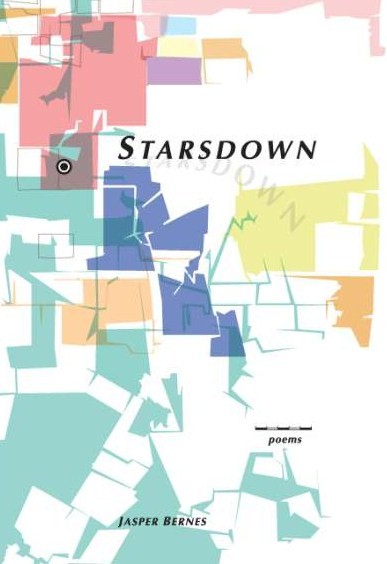
There's a review of Starsdown in this month's issue of The Believer. Thanks to Stephen Burt for the generous read! He also wrote a note about the book here.

*

I'm not writing much here lately, as is obvious, because I'm deep in the dizzying bookpile that is my reward this year, studying for my qualifying exams in May. There's nothing like reading as much as I can of literary product from the last two centuries (American, mostly) to induce a sort of aphasia, or convince that there's very little that can't be said better with the backspace key. I'm sure I'll figure out some enabling delusion soon, and then I'll be back. But probably very little until summer.

Saturday, November 24, 2007

I is an Arthur

I'm Not There is terrific. The idea, I suppose, is to play Bob Dylan as a series of covers, and part of the frisson of the film is to watch Dylan's doubles, despite their will-to-elusiveness, to fiction and Rimbaudian auto-exile, coalesce into the mise-en-scene of the all-familiar album covers, the all-familiar quotes, the freeze frame of celebrity. "The individual who in the service of the spectacle is placed in stardom's spotlight is in fact the opposite of an individual, and as clearly the enemy of the individual in himself as of the individual in others. In entering the spectacle as a model to be identified with, he renounces all autonomy in order himself to be identified with, he renounces all autonomy in order himself to identify with the general law of obedience to the course of things." That's the rub, no?

I'm still trying to work through Todd Haynes's gambit with regard to minstrelsy in Dylan (and American music generally). Casting the teenaged Dylan as a twelve-year-old black boy (the terrific Marcus Carl Franklin) named Woody Guthrie, Haynes might succeed in indicating the distance between the young Robert Zimmerman's self-fashioning and the actual experience of African-Americans incarnated, freely or not, in American music. Or not.

And wasn't this, also, what Godard was trying to work out in his own problematic way in Sympathy for the Devil, by juxtaposing The Stones' appropriated blues with the Black Panthers' training for an armed reappropriation? In fact, I'm pretty sure the scene where Blanchett-as-Dylan chases Michelle Williams's Edie Sedgwick character through a winding English garden is an allusion to the great All About Eve vignette in the Godard film: "He doesn't want to answer?" "No." "You're calling LeRoi Jones?" "Yes." "Or Cassius Clay?" "Yes." "Or Rap Brown?" "Yes." Yes I said yes.


Wednesday, October 03, 2007

The chance meeting of Jeremy Bentham and Friedrich Schiller on the floor of the NYSE

The following quote, from an article by Brian Holmes about recent art-into-life experiments and their unexamined collaboration with techniques of people-management, is exactly what I was getting at in my essay over at Action, Yes. Worth checking out.

_________________

The concept of ‘deep play’ – or the quality of artistic excess that Bruegger and Knorr
Cetina wanted to transfer from Clifford Geertz’s Balinese cock-fighters to their own
postsocial traders – was itself, as a kind of intellectual fate would have it, an invention
of Jeremy Bentham. He used it to describe the irrational activity of inveterate
gamblers, whose speculative excesses could not be resolved into any calculus of
individual pleasure, and should therefore be outlawed. Geertz sought to go beyond
Bentham’s shallow moralizing by portraying the deep play of Balinese gamblers as an
arena for the meeting of self and other, an affirmation of the social tie. But in a further
turn of the screw, it is now this speculative irrationality that lies at the heart of a selfdenying
and ultimately self-destructive tie, in the age of a fully realized post-social
Benthamite utopia. And this is what we are being taught to calculate, this is what we are
being encouraged to create in the cultural field.

What has to be understood, expressed, and then dismantled and left behind in the
movement of the artistic experience, are the specific modalities whereby the planetary
middle-managerial classes share, through our work, our labour, in the concrete
deployment of sovereign, disciplinary and liberal devices of power, and in the depths of
systemic madness they together configure. I have focused on the relations between the
cultural and financial spheres as a key articulation that permits, structures and at the
same time hides this deployment of power over the movements of both body and mind.
It is precisely this articulation that should be challenged, questioned in its legitimacy
and its very sense, so that the entire communications machine of cognitive capitalism
can be used to open a debate on the crisis of the present. The systemic ‘device’ must be
confronted by deliberate and delirious processes of social experimentation, which can
dismantle it, derail it, while opening other paths, other modes of production and selfproduction.
This is the counter-urgency of our times.

Thursday, September 20, 2007

Equinoctial

By pure coincidence, two products of my summer's leisures are now available.

1) I guest edited an issue of the online journal (Counterpath Online) run out of Counterpath Press. It features works by Karen Leona Anderson, Joshua Clover, Dolores Dorantes, Gabriel Gudding, Charles Legere, Ange Mlinko, Jennifer Moxley, Jennifer Scappettone, Suzanne Stein, Rod Smith, David Weiss, Allyssa Wolf and Mia You. Please do read my editor's introduction, as it explains the experimental format for the issue.

2) I also wrote an series of theses, "On the Poverty of Internet Life: a Call for Poets," for Joyelle and Johannes's Action, Yes. My hope is that they will provoke some conversation, and that, moreover, around them some political (in)activities or (dis) organizations might emerge in which the special skills and maladapted bodies of poets can be made useful. Action, Yes has a discussion board, so you should chime in. Or, you can send me a message by destroying your local INS or military recruitment office with a poem by Mallarme. That's actually much quicker than e-mail. [Note: just so you know, I think my piece reads a bit better in the printer-friendly format.]

In all, it looks like a terrific issue. I've already read Josh's talk on the baroque--a subject that won't leave me alone of late-- and Ariana Reines's poetics statement. Both pieces are, I think, in dialogue with each other (and with my essay) in ways that seem, at first glance, fruitful.

Wednesday, September 05, 2007

Reminder

OK, so the reading/book release in Brooklyn is more like 6:45, Sept. 10th: I read and Jeffrey Jullich reads; there is film by Brandon Downing and introductions by Joshua Clover and Mike Scharf, all of this in celebration in girum imus nocte et consumimur igni, and therefore perfectly uniting the form and content of perdition.

At Pierogi 2000 in Williamsburg (77 North 9th St. Brooklyn, NY). Not Leipzig, sorry. See you there.


Friday, August 24, 2007

Because I've Been Reading Lots of Ange Mlinko Poems

Announcing my trip to New York got me thinking about how much I love the neighborhood where I usually stay when I go there these days, where one of my oldest and dearest friends lives, in a swaybacked, tilting edifice that will soon, if it's not condemned, collapse, taking with it the rest of the doomed neighborhood. Barricaded on three sides, more a cul-de-sac than a neighborhood, it’s not very well known, even among friends who’ve lived in NYC for decades. Recently, he tells me, one of the many, ancient out-buildings on the property collapsed, and the tenants, knowing that they lived in some of the very last affordable apartments in all of New York City, rented a van and quietly cleared away the debris before it alerted the no-doubt senescent, probably fictitious, owners to the perilous state of suspension in which the building proper stood. The property abuts a vacant lot of dead cars and other gorgeous detritus the exact dimensions of which I've never been able to gauge, so overgrown is it with the kinds of prodigious trees that no-one bothers to remember the names for. Perhaps it's infinite, that lot.

Behind this property is a first-five-minutes-of-a-horror-movie gated mansion with many once-elegant vehicles parked on its premises, and behind that you can see the open tanks of the sewage processing plants they like to put in these neighborhoods. Anywhere anybody I know who lives in New York lives is always within olfactory range of one of these. And, behind the mansion, the barracks and officer’s housing of the Naval Yard. Or, depending on which way you look, the projects.

In the other direction, far too close actually for an encounter with the industrial sublime, there’s a Sheeleresque power plant that, on hot days, in summer, emits the kind of noises a power plant might make if it thought it were imitating a sick cat. The heat waves roiling off it are entertainment enough for drinking on porches.

But then, the neighborhood itself, the neighborhood proper, is cobblestone streets, 19th-century storefronts, and street names that bespeak a vanished world of small merchants and craftspeople and other non-existents: Gold St., for instance. It’s Whitman’s Brooklyn, and indeed, his beloved ferry is only a few blocks and one-hundred twenty years away, where it meets Crane’s Brookyn, on the other side of the two bridges.

So, it’s a dialectical image, this neighborhood. The smaller, picturesque scale of the 19th century, seemingly livable only because of the patina of time, meeting smack against the inhuman, definitively unlivable dimensions of the 20th. Rendering both parties, once tragedies, farcical. And between them both, home. Except that, everywhere, in every direction on the horizon these days, the new farces: the gentrification-lesions, the sleek speculative highrises of 21st-century Brooklyn come to end this little détente of the dialectic. If the timing’s right, the sound of the trucks on the BQE bouncing off their shiny, echoic and life-resistant surfaces makes it sound as if they were whispering to each other more gossip about Frank Gehry.

Thursday, August 23, 2007

Book Release/Reading

It seems like it might be now neither too early nor too late to announce that I'm having a book release/reading for Starsdown in Brooklyn, at the Pierogi Gallery, on Sept. 10th (come at 6:30, reading at 7:30). With Jeffrey Jullich.

Since any city is better than no city when writing about a city and living in the country, it just so happens that I wrote much of the book in Williamsburg and across the river and north in Greenpoint. I'm happy, then, to share it there.

So: come. It'll will get you prepared for the next morning when you will wake up and realize that it was six years ago that neoliberalism and neoconservatism found the perfect opportunity to work out their differences, make a pact on the floor of the Oval Office, marry their contradictions and play goodcop/ badcop unto our interminable ruination.

Pierogi Gallery: 2000 Gallery, 177 North 9th Street in Williamsburg (Bedford stop on L train).

I'll be in town from the 6th until the 11th. I'm excited to catch the Richard Serra show at the insanely overpriced Mausoleum of Modern Art. I'll probably be at the book party for American Poets in the 21st Century on the 8th at the BPC and J-Clo's reading in Bryant Park on the 11th.

Tuesday, August 14, 2007

Anne has very insightful things to say about Starsdown (and Mike Scharf's terrific For Kid Rock Total Freedom) over at Odalisqued. It may not be a review, but it is un rêve, vu . . .

It is true that the book is partly about money, a phenomenon which, despite all of my distasteful reading of texts that talk about capitalism as if something else were possible, I still do not understand even a little bit. I realized (again) how little I understood money when Noah asked me, on the way back from his swim class, where the quarter I had given him (because he's into bald eagles, not as payment for goods or services received) came from. "That, as it turns out, is a very long story. "

Tonight, before bedtime, instead of the stories I make up while lying on my back next to his crib (about owls and allosauruses and deinonychuses and little boys named Noah), we're going to start with Capital Vol. I.

Saturday, August 11, 2007

I keep forgetting things. Along with Kasey's post, one of the things that got me going on this line of thought was the following quote from Jameson's afterword to the terrific Verso book Aesthetics and Politics (1977), a collection which has the salutary effect of leading one to recognize how many current arguments merely recapitulate those between Ernst Bloch/George Lukacs or Adorno/Benjamin in the context of early 20th-century modernism and the avant-garde:

For when modernism and its accompanying techniques of 'estrangement' have become the dominant style whereby the consumer is reconciled with capitalism, the habit of fragmentation itself needs to be 'estranged' and corrected by a more totalizing way viewing phenomena. In the unexpected denouement, it may be Lukacs--wrong as he was in the 1930s--who has some provisional last word for us today. Yet this particular Lukacs, if he be imaginable, would be one for whom the concept of realism has been rewritten in terms of the categories of History and Class Consciousness, in particular those of reification and totality. Unlike the more familiar concept of alienation, a process that pertains to activity and in particular to work (dissociating the worker from his labour, his product, his fellow workers and ultimately from very 'species being' itslef) reification is a a process that affects our cognitive relationship with the social totality. It is a disease of that mapping function whereby the individual subject projects and models his or her insertion into the collectivity." (212)

Many will, I'm sure, recognize how this early formulation presages his later work on postmodernism, not to mention his contentious reading of the status of the fragment in Bob Perelman, a reading which someone once dubbed (who was it?) "the primal scene of language poetry."

*

The link to the SPD page below was broken. It works now. And for some reason, my e-mail was not displaying in my blogger profile. But that's fixed now too, I think.

*

Also, how awesome is Stephen Rodefer's Four Lectures? Along with Harryette Mullen and the obvious ones like Shakespeare or Joyce, one of the best all-time punsmiths. (Sadly, I see that ECLIPSE has removed its pdf edition in advance of a reprint from Barque Press. I suspect that the availability of the former would diminish sales of the latter not at all, if it did not, in fact, increase them. What do others think?)

"Pass me a little of that petit pain."

Tuesday, August 07, 2007

Estrangement and Comfort

I'm a bit late on the uptake, but I wanted to note how useful I found this post, of Kasey's, about the constitutive tension between, on the hand, the negative, estranging (ostranenie or verfrumdungseffekt) aspects of contemporary poetry and, on the other, its will to presence or immediacy (projective or breath-based poetics, for instance). I do think that, in post-45 American poetry and poetics there is an unexamined conflict between a poetry of immanence and a poetry of artifice. Unexamined because, due to other similarities and values, writers who work one end or the other of this spectrum tend to get run together in the great hagiographical encyclopediae of our day. It's worth saying that an attention to these differences might--like Hejinian's sense of "experiment" as a relation to the real--allow for diagonals and diagnostics that cut across the quietude/new American binary.

But more importantly, the post makes me realize that I might not have expressed as well as I wanted to one of my points vis-a-vis Juliana Spahr's The Transformation. That is, I think that there's a kind of habituation curve to negativity in poetry, a process whereby the initially estranging or alienating technical effect--the fragment, for instance--becomes either strangely comforting or, alternately, gets so subsumed by mass culture, as to become somewhat toothless. The Dadason Avenue problem, we might call it. In such a moment, without an attempt at reinvention or an acknowledgment of the changed conditions, the mechanical continuance of such techniques becomes either amnesiac or cynical.

My sense is that Spahr understands her post-New American audience well enough, and is at least partly directed to that audience enough, that she realizes that a poetics of simplicity, referentiality, honesty, that at the same time continues to employ some of the stylistic markers of "fragmentation, quotation, disruption, disjunction, agrammatical syntax," will, in its own way, really fuck with people. She creates an especial estrangement for readers who have become habitutated to estrangement, readers for whom there has been a kind of ostranenie saturation. For example, in the aftermath of 9-11, while the characters in the book are in New York, Spahr notes this curious reversal with a tone of optimism: "And they began at this time to think of the poetry that used fragmentation, quotation, disruption, disjunction, agrammatical syntax, and so on not as a radical avant-garde break but as the warm hand of someone they loved stroking their head, helping them to relax the muscles in their head and inviting them to just close their eyes and relax for a a second with words of someone else. This feeling somewhat answered that constant question about the use of the avant-garde in a time like this" (188).

At first glance, I find this formulation completely inadequate, a sentimentalized notion that sells poetry short. And, of course, this is precisely what I'm supposed to feel. Indeed, by feeling that way, by attending to the balance of both estrangement and comfort within the book, I have fallen right into the trap-of-sorts that the book has laid for me. I do not think it is incorrect to assert that this is an extraordinarily strategic book, one that understands its readership well, and one that seeks to work with and against it. And it's precisely Spahr's acknowledgment of the conditions (embarrassing to many, I think) of her readership that allows her to do what she does. Has any poet ever so cannily worked the dialectic of comfort and estrangement? Maybe Stein's deterritorialization of the spaces of comfort and domesticity in Tender Buttons.

I use the word "canny" as my own strategic move, for I think that Spahr's work is quite close to Freud's essay on the uncanny. Both writers have a remarkable sense of the dialectic whereby the familiar (heimlich) is repressed and returns as something uncanny (unheimlich), but uncanny precisely because it retains elements of the familiar. You can see this dialectic at work in the changing political conditions of the move from Hawaii to New York that I mentioned in the earlier post. It's worth saying that this is the kind of effect that those whose accounts of poetry are entirely technical or impressionistic (which is, to say, 4/5 of all poetry reviews) will never take the measure of.

While I do hesitate to open a can of assvagina in a studiedly neutral post, this may be the key to the work that elements of the "cute" do in some Flarf, where, amidst all of the estranging verbiage and allusional range, the cute serves the same purpose as the familiar/comforting does above. For a brilliant reading of this exact issue, check out Sianne Ngai's essay "The Cuteness of the Avant-Garde." (If you have no JSTOR access and want to read it, e-mail for a pdf). I love to steal from the institutions of High Theory! Death of the author, put your money where your mouth is!

Monday, August 06, 2007

I am an author


now available for purchase through SPD. Alternately, you can save a few dollars and buy the book from me directly (e-mail is above). Review copies are also available.

Jasper Bernes’s magnificent and multi-layed first book, Starsdown, emerges to take the measure of the last American city as its physical space collapses into specters and marks, where “the sky is a swimming pool,” and the signs and stars keep switching places. Beneath Los Angeles’ glittering, flat surface, the blurring of utopia and ruin: this book animates the profusion of irreconcilable vernaculars and histories that the city’s “pastel-washed meta-burglaries” have contrived to make disappear. In Bernes’s vision, hardboiled and crackling through the post-Pynchonian circuitry, the bars are named The Regrettable Incident and the cry is for “Socialism or Barbie.” Here Walt Whitman and Walt Disney, Adorno and Ice-T, gumshoe noir and Divine Comedy meet in the parking lots and derelict spaces that Nathanael West once described as “a Sargasso of the imagination.” An archaelogy of futures past and futures to come, Starsdown improvises a poetry which stands finally as actual invention and possibility: “a field the discovery of which / might mean a / Northwest Passage cut right through every home, car, tower / fear monumentalizes.”

Tuesday, July 31, 2007

Ingmar Bergman 1918-2007; Michelangelo Antonioni 1912-2007


What are the chances? Bergman one day, Antonioni the next. It's really over, the 20th-century, modernism, all that.

I thought of Antonioni, yesterday, as a point of comparison as I mused on what I might say about Bergman's incomparable films.

About Bergman, it's this: in both the b&w and the color films, I do not think that anyone has succeeded in giving light itself so many variable and ambiguous meanings, such substance. That eternal twilight of the idols, beyond good and evil, on his personal island, etc. . . I cannot but feel impatient, after Bergman, with a film that returns to the Manichean symbolism of neo-noir chiaroscuro. Although it seems perverse to focus solely on the visual with a filmmaker who is so novelistic, so theatrical and psychologically sharp, as in Fanny and Alexander or the Passion of Anna or Persona or Through a Glass Darkly, for instance--still, it's mostly light I'll remember. Everything seems great now, in retrospect, even the early allegorical films.


And Antonioni? No-one, I think, has better fit the dream of Malevich and Picasso and Mondrian to the space of the screen-projection, the dream of abstraction. That qualities might float from free from all substance, migrating somewhere else, somewhere better. That you could refound the world on a color, a shape, a sound, an itch. At the end of The Passenger, that anxious and yet solemn circling of the camera in the dust, so much more of a person than most of us ever get to be. Something sat down in the middle of the bourgeois world--an organ of non-communication, some call it spectacle-- and Antonioni took its picture.

But Antonioni lives on in Taiwan and Hong Kong and China, in the films of Hou-Hsou Hsien and Tsai Ming-liang and Wong-Kar Wai, Antonioni does. Where Bergman is I don't really know.


All the people I mention in this post who are not fictional are men. That's another part of it.


Friday, July 27, 2007

How to Not Think and Dominate People

Over dinner last night, Tim Kreiner and I decided that the proper response to the Sarkozy government's remark that "the French think too much" would be a gesture of American solidarity in non-thought. We could immediately send Bush and the rest of his government to France as special envoys of not-thinking. He could head his own department of sophism, rhetorical misfire, and false commonsense. The new propaganda: a blank page. The new early warning system: 4'33''.

I think I know what "not thinking" means, a special kind of thinking too much, the thought of what is, of the status quo over and over, that complicity stitch. You see: as the baptism-gift of my class, I was given at birth a special certification in not-thinking: no alternatives, no discontent, no political solutions that involve doing things, just the non-thought of the market, the war, grinding away at bodies and lives. But for the fortunate classes, freedom from thought, from necessity! What glories: an underlit Ketamine lounge, where the placid, pacific sounds of TINA and the End of History gurgle away in the background .

Thought: current that leaps the distance between what is and what could be.

Tuesday, July 24, 2007

Daddy, I'm going to turn you into a plant, and then you can't tell me what to do, and I'll keep you in the house and water you around your eyes.

Later:

Daddy, you are a toy! You can't tell me what to do. You are plastic! You are a sidewalk! You are a beard!

Cogito 2.0: I think, therefore I'm spam.

The Transformation

Perhaps because I am easily fatigued and often fatuous, I like the word indefatigable, its too-many syllables beaded along a quick, trochaic string. I also like Juliana Spahr’s new book, The Transformation, an indefatigable memoir-of-sorts, although the term memoir fits this work about as well as it does A la recherche du temps perdu.

There is a remarkable patience to this book, a perseverance rare in this age of point-and-click blandishments. And yet, how different her indefatigableness is from its modernist predecessors: Beckett’s “I can’t go on, I’ll go on,” for instance, or Stein’s steadying, spreading repetitions. This is not the indefatigableness that Sianne Ngai incisively dubs “stuplimity.” Not a tirelessness that assaults, that tires her out, as a fisherman might reel in a swordfish and let it dive hundreds of feet, reel it in and let it dive, until it can dive no more and is hauled onto the deck of the ship and clubbed to death. This book is not like that.

As much as The Transformation displays many of the markers of this tradition, style here is not necessarily a form of resistance, not a way of enforcing the art object’s autonomy. Rather, it’s a way of not foreclosing thought (Lyn’s resistance to closure), of not prematurely deciding. I can think of no other work right now that displays the same patience in exhaustively detailing the million political ambivalences that ramify around even the smallest action, nor can I think of one that does a better job of detaching ambivalence (or “negative capability”) from a kind of quietism. Nor can I recall a work that is as untiring in greeting each political situation with a willingness to rethink even the most foundational of presupposition. That’s to say, I’m embarrassed by how unembarrassed this book is.

Lately, there have been many thinkers on the left who like to, umm, talk shit about relativism, which also usually involves a critique of identity-politics and multiculturalism. Some of these critiques are subtle and interesting—Alain Badiou’s, for instance—and some are plainly the idiotic result of that conservative psychosis (Hitchensitis, Lyotarditis) that often afflicts writers on the left who don’t, like, take a chill-pill every once in a while: Walter Benn Michaels, for instance, whose factota are even known to haunt the comments-field of Ron Silliman’s blog. As I often feel with good writing, Spahr’s book, resistant as it is to “theory,” provides a useful counter to these positions, reminding me that Marxism was, first of all, a form of relativism, one that tied the things that could and would be thought to the relative positions and practices of the thinkers within the absolute but perhaps also ineffable field of history. And so, in The Transformation, the contradictions that must be enumerated and the political positions—nationalism, for instance—that must be countenanced and lent support in Hawaii, are precisely the positions that must be rethought in post-911 New York. Each situation requires its own ethos, its own particular mode of responding.

Despite or maybe because of its contraindication here, and following some of the discussion on Josh's blog about aesthetics and ethics, I’m reminded of Badiou’s own notion (in Ethics: an Essay on the Understanding of Evil) of a non-normative ethics (and hence, a kind of anti-ethics in his definition)—that is, an ethics not based upon norms or protocols but one where, in the aftermath of a significant “event,” certain resistant forms of relating stabilize and come into being, certain individual and collective subjects to which anyone can claim allegiance. Ethics, in this formulation, involves remaining faithful to these subjects in a positive, affirmative manner. The only thing that is un-ethical in such a situation is either, on the one hand, losing faith when it is still possible to continue under the aegis of the event or, on the other hand, trying to force such inter-relationships through norms and protocols rather than through voluntaristic allegiance.


In Spahr’s book, there are, broadly, three such events: the advent of her love relationship with two other people (and the triangle’s “indefatigable” self-affirmation in the face of others’ bafflement); the U.S. colonization of Hawaii, and the resistance that it requires or makes possible; and the attacks of 9/11 which, as we know, reshuffle existing political formulations and require for the left a deep reconsideration of its political strategies.

The triangular relationship, which is the center of the book, and carries over from the second situation to the third, forms a kind of model for this ethics, I think. A form of ambivalence—a both-meaning—that precisely doesn’t mean lacking conviction or lacking the will to act. If it is an ethics, it is not one that sets down norms, rules or procedures but rather that seeks to find ways that one might persevere within a particular situation. In this it’s a powerful and moving model of the kinds of open-ended vigilance and fortitude that the present state of the disaster requires.

*

Speaking of which, if you haven’t read already, do look at this disturbing summary of the conclusions drawn from The Nation’s extensive interviews with current and former Iraq War soldiers. That the American occupation involves the continuous, ubiquitous killing, maiming and humiliating of millions of Iraqis will no doubt not surprise most of my readers, but it’s probably some of the best evidence of the extent and progressive worsening of these atrocities. A good thing to point to if you’re in conversation with someone who wants to claim that such events are rare—that is, someone who only reads mainstream new sources.

Needless to say, another reason we shouldn’t need for an immediate withdrawal and not the absurd troop-reduction-and-extensive-bombing plan we would likely get with Colonels Clinton and Obama (both of whom just signed off on an attack on Iran last week). Here’s hoping a real anti-war movement manifests.

Monday, July 02, 2007

Coolidge, Lowell and the Photo Poem

I can’t shake the idea that Clark Coolidge’s Own Face, the first book from his so-called autobiographical turn, is to some degree an explicit attempt at an experimentalist’s version of the confessional poem. The whole book seems to reverberate with echoes of Robert Lowell.

I am not saying, of course, that the reflexive distinctions we might generate here—experimental vs. confessional—won’t largely hold; but it’s worth considering, if only to irritate those who like their distinctions clean-edged, that there are a number of similarities between Coolidge and Lowell. First off, both are pessimists (or, as the case may be, realists) who situate their poems amidst a culture in decline, post-industrial tableaux of rusting, abandoned factories, quarries and broken concrete structures. I’d even say that both flirt, at times, with a kind of nihilism. And, furthermore, their diction choices and rhythms (quite apart from the very different phrasal and grammatical arrangements) are strikingly similar: heavily Anglo-Saxon, long on consonants and consonance, pulsatile. Perhaps, the common point of departure here is Melville.

Coolidge:

. . . Later I reel
in a yell as my cousin takes a bite from my shank
beneath ranchhouse breezy curtains of Marion. On a trudge up
from the gasoline rockpit in the gaze of Judy Lamb,
she carries my pack, my jeans rolled as I step on
pipe. . .

[“Album—a Runthru”]

Lowell:

I picked with a clean finger nail at the blue anchor
on my sailor blouse washed white as a spinnaker.
What in the world was I wishing?
. . . A sail-colored horse browsing in the bullrushes. . .

[“My Last Afternoon with Uncle Devereux Winslow,” ellipses Lowell’s]

Indeed, although I don’t think I’d stake any kind of argument on this— (consider this a series of provisional mental sallies)—without a bit more to go on, there are at least two moments in Own Face that sound like explicit Lowell quotations. For instance, Coolidge’s “a burst the cleat of harp / mark vine wild to hog hill red fox Morman behind the Hilton. . .” seems to invoke Lowell’s brimming iambic line “A red fox stain covers Blue Hill” from his super-famous “Skunk Hour.” Of the same poem, compare these two stanzas:

One round night, I’ll term it that pulling
some depth on my cube. Far from starring the black
books holding meat, the babies that plow
down the chute, unable to grasp still
starring. Not apt to finish I’ll fix the sun
on lock. Then walk down the stairs
in the woods under lights.

[“The New Look Sways”]

------------------

One dark night,
my Tudor Ford climbed the hill’s skull;
I watched for love-cars. Lights turned down,
they lay together, hull to hull,
where the graveyard shelves on the town. . .
My mind’s not right.

Perhaps the title of Coolidge’s poem is meant to recall Frank O'Hara's comment about “Skunk Hour”, one that for all its drollery, doesn’t, in its revealingly genteel sense of decorum, actually do much to distinguish O’Hara’s “I do this, I do that” from Lowell’s “I myself am hell.” The quote: “I don’t think that anyone has to get themselves to go and watch lovers in a parking lot necking in order to write a poem, and I don’t see why it’s admirable if they feel guilty about it. They should feel guilty. Why are they snooping?” If it is a poem about prohibited gazes, then Coolidge’s “black books holding meat” does much to physicalize the halo of shame which rings the voyeur’s object of desire.

The condition of the gaze, then, is where the two poets part ways. Both of them figure the poem, and the collection of poems, as photo and photo-album. But their takes on the enduring presence of the past, its accessibility or lack thereof, diverge sharply. For Lowell’s Life Studies, the dominant metaphor for memory is travel. The gaze slides into the past like a train crossing the Alps (“Beyond the Alps”) or a boat returning from Europe across the Atlantic (“Sailing Home from Rapallo”). Coolidge’s past is geological, not a destination to which one must travel, but an ossuary which one must sift through, a ruins, a geological record that only exertive, even exhaustive, labor will recover. Time in Lowell is transparent, extensive and empty. In Coolidge, it’s opaque, accretive, and intensive.

Still, despite these differences, the tone and stance of both poets, looking at an empire in decline, a senescent culture, the renewals of which are merely disguised ruination, is basically the same. Emptiness-meaningless and opacity-meaninglessness give way to the same sense of irreversible entropy (a metaphor that both poets find recourse to). In the end, though, Coolidge may have more of a future than Lowell (and I say this as somebody who thinks Lowell is an important and, among many of the poets I know and read, underread poet). His punning sense of the photo-album as a musical album, a "record" that can be played or even “covered,” that is performed may model a more active, less contemplative to our national ruination. This will constitute my only remarks about the day of singed flesh and gunpowder known as the 4th of July.


[*Funny that Kasey wrote something about Coolidge just yesterday, and with a similar polemical drift.]

Monday, June 18, 2007

After I Argued with the Learn'd Astronomer

I came across this truly chilling U.S. government document, and its equally chilling website. Indeed, I wasn't sure, at first, that it wasn't some kind of NGO that ran the website, but no. Singling out Jews like this (no one else has their own page, right?), as especially deserving of protection from campus discrimination, is so nauseating that I can't even imagine what I might say in response. Coming on the heels of Alan Dershowitz's libel campaign against Norman Finkelstein, which succeeded in getting the dean at DePaul to deny Finkelstein tenure, despite his absurdly long list of qualifications and credentials, one has to take one's hat off to the attack dogs of the Jewish right. They're really getting things done.

No doubt, the "reverse racism" page will be up soon, too.

The whole thing, with its blurry warnings about criticism of Israel, is ugly, but it definitely crosses the line here, in this definition of anti-semitism

* Comparisons of contemporary Israeli policy to that of the Nazis, or comparisons of Israeli/Jewish leaders to Nazi leaders, or comparisons of Jewish symbols such as the Star of David with the swastika.

The most absurd item though, is the one that defines remarks to the effect that "Zionism is racism" as anti-Semitic. Looks like academics should be careful about what they say. But, oh wait, it seems the the website has acknowledged that there's NO legal precedent for their definitions.

Glad they've gone out of their way to enforce something other than the law. As for civil rights law itself, well. . .

Some Responses

[Update: not incidentally, there's a post on related questions over at Style of Negation]

In the
comments box of Kasey's Limetree, Sweet Jane and the indefatigable Kent Johnson were debating the merits of Zizek's recent interview in Soft Targets, a journal that imagines itself a Bataillean investigation into violence, a latter day Documents. Kent, misconstruing the points that Zizek made (who was sounding more reasonable than usual, it must be noted) declared that Marx would probably have "largely" discarded the Labor Theory of Value today (Simon chimes in, equally incorrectly, to my mind). The only possible response to this is, I think, like

(insert strange facial contortion here, upturned palm, here)?????

I respect Kent and think that, when he's not paranoiacally worrying that Flarf has gone all Baader-Meinhof on him, he's capable of making strong arguments, but huh? Last time I checked almost everything within my range of vision was produced by, to some extent, people who, not owning the means of production for such books, tables, foodstuffs, diapers, etc., did not receive as compensation for their labor its social value. . . Is everything made by machines where Kent lives? Does he have one of those Star Trek mystification-thing-a-mabobs? Can I get one? As for the following idea, of Simon's:

There is a great deal of "violence" in captialism; what I am most engaged by is that this is a deeply indirect violence, a violence done to the psyche, to the soul, to the spirit. It's an armchair thought in many ways, but I, at least, am aware that the greatest suffering of this psychic violence are precisely those that we -- meaning people like Josh and I -- are most concerned with politically.

I can only say I would like to see Simon explain this to a Pakistani person who works 16hrs/day for less money than it takes to feed his/her family. Do you think this person wants a psychic solution? Or the value of his/her labor? Therapy or health care and full remuneration? OxyContin of the masses? This sounds to me like the worst of liberal idealism. Sadly, this is a tendency that anarchist thought, much of which is very valuable to me, and important to my anti-vanguard politics, can fall into quite quickly (cf. Chomsky channeling Rousseau and telling Foucault, ridiculously, that he thought that people were basically foundationally good ). I think I take the side of Marx in The German Ideology against Stirner/ Feurbach. Idealist thinking like this only further proves that Marx is, in fact, deeply useful today. To the extent that I am not aware, every time I drink a cup of coffee (as big of a commodity as oil), that this is a relationship between me and somebody working a plantation in Nicaragua, then Marx's analysis of the commodity still holds. . . And it's not common sense if nobody ever talks or thinks about it when they invite you over for coffee.

The point that Zizek makes in the beginning (via Benjamin) and that Joshua reiterates, that capitalism involves a repetitive, sustaining (law-preserving) violence, that is the very foundation for those soi-disant acts of poor on poor violence, needs to be repeated until people understand it. Unemployment, broadcasting of classist/racist ideology, lack of adequate housing, social services, education, etc., these are bases for Simon's poor on poor violence. I don't know if therapy (psychic solutions) or religion (spiritual solutions) will be much help here. From the idealist, pre-Roussauvian tradition, how about this:

I conceive there is more barbarity in eating a man alive, than when he is dead; in tearing a body limb from limb by racks and torments, that is yet in perfect sense; in roasting it by degrees; in causing it to be bitten and worried by dogs and swine (as we have not only read, but lately seen, not among inveterate and mortal enemies, but among neighbors and fellow-citizens, and, which is worse, under color of piety and religion), than to roast and eat him after he is dead. (Montaigne, "On Cannibals)

I agree, for sure, that there's a contradiction between Zizek's advocation of, on the one hand, absolute refusal, and on the other, the seizure of state power for the purposes of socialist political change. [What do you get when you cross these two? A state that does nothing?]. In any case, Zizek does say he only supports Hamas to the extent that they want to destroy the increasingly the rogue state of Israel, not kill Jews. More and more, that seems like the rational response to the political situation.

Below, an excerpt from an essay I'm writing for Johannes's and Joyelle's Action, Yes, might constitute some kind of response to Kent and Simon.

6. In the internet, the commodity appears to have committed suicide. This is the “communism of capital.” The abundance of the developed world, those final fruits of a half millenium of exploitation, are delivered right to your living room, they are manipulable, plastic, they have a history that recedes into the future. But they are also completely purged of any substance. An equality without qualia. Everyone gets their fifteen embarrassing minutes of fame, yes, but everyone is always someone else.

6.1 That is, everything arrives “just in time,” meaning never. Without an ideological enemy in sight, without opportunities for fixed capital investment, and with an increasingly dephysicalized work force connected more and more by cheaper communication networks, but who were without adequate health care, unable to buy houses, unable to afford the luxuries constantly promised them, it seemed that, for the legendary “average American,” social unrest would be the order of the day. The internet gives this unrest an arena. Riot on the discussion boards, not the streets. So, too, were the rise of “alternative” and “indie” and “non-mainstream” forms of cultural production a means of capuring truly anti-capitalist sentiment at the end of the American era. The methadone of the masses. Pseudo-satisfactions for real needs.

Information is the New Body Armor

7. The internet is not separated from the real geography of the world by a continuous border. Rather it is folded intensively into this geography. It lives in the pores of the real geography of the world, copresent. Without our knowing it has walled, sectioned, cantonized and infiltrated at multiple levels the space of the real. When a real geographical space is enveloped on all sides, without egress, alternate temporalities, too slow or too fast, begin to form. These can spread and are, in other terms, what is known as revolution. Fredric Jameson’s important call for a cartography of the totality of postmodern space is, ultimately, victim to a certain structuralist predisposition to synchronic spatialities. Sadly, the structure of the internet is subjected to the shuffle play of capitalism’s unconscious and so, on its own, a map will merely allow one to wander in weird ellipses inside the lung-sac of the breathing, sweaty folds. Rather, we need a a kind of proprioception of the collective, a form of class hatred, hatred of capital, a compass that blinks, brightly, beside the red light of TINA (There is no alternative) the green light of EXIT.

8. The internet, then, is a Green Zone, a distribution of autonomies and dollar-forms, templates, in which the miseries of the world arrive shorn of all their burdensome material determinators and accumulates. With nasal, aristocratic delectation, the provisioners of MySpace toss out the m’s and n’s to the multitudes in order that it not spell “internment” or “interment.” We are all interns at Google, producing value whose redemption is scheduled for a future to which we will not be invited.

9. Social software: the porous, osmotic hyper-sensitized softness of which masks the rigidity of its regulative supports: it feels like consumption, but it’s really production. Anywhere a price is prominently missing, it’s production: of false needs, of distraction, and most importantly a production of social relations vital to the precarities of the present. I will not say, like some, that the petit-bourgeois of the blogs and listservs, laboring in para-corporate purgatorial cubicles, have become a revolutionary class. If there is to be revolt against capitalism, it must no doubt occur from and with the developing world, the massively displaced peasantry of China, the orbits of dispossession and immiseration, hunger and disease and bad faith ringing Sao Paolo and Lagos, not to mention the least developed parts of the post-industrial world. But laboratorial leisure, leisure made labor, provides a crucial supplement, a clean distribution of experience necessary for the functioning of capital today. As this petit-bourgeois class becomes, more and more, a kind of second proletariat, as the teaching adjuncts and clerks and “executive assistants” who provide much of the content of the internet get forced below a living wage, such tertiary or quaternary production becomes more and moe necessary. These classes need to organize as well. Their—or our—refusal is essential. Those who would controvert such a notion, by pointing to the absence of internet commodities produced for exchange and assigning to web denizens the role of cultural reproduction, misunderstand the nature of the post-Fordist economy. Rather than commodities arising to mark the unevenness of development between classes and countries, it is this uneven development itself which the web produces.


Friday, June 08, 2007

Two Old Posts


1. As ever, proofreading, I am aware of the strange punctuational malady from which suffer: hyphenism, characterized by gratuitous and ornamental bridging of modifiers and nouns with hyphens. (Not to be confused, of course, with hyphy-ism [more on this later]). I am anxious about connections, anxious to make them. Am I making sense yet? I want you to nod your head. But, oh, things fall apart--nor all the king's adverbs, nor all the king's sutures, prevent the unchaining of the signifier after the cops visit the party and tell the people in charge to turn the music down and then drive away to do cop-type things.

Nor does the recourse to the indirect style of the fragment really help matters, forcing an attention to the types of coherence that are internal to phrase units, to meaning units. The layering and proliferation of polysemousness, of vernaculars, puns, auras, mediations, icings and smogs is, it seems, also another attempt to make things stick, connect.

The pin near the top of the assemblage pops out. It holds a thread which, wrapped anxiously and multiply around each of the links, those little dead spots in thinking, makes it seem as if these words actually fit together, had receptors and nodes and agendas and budgets and all that. But no, they just drift away from each other in zero-g.


2. One month ago or so: a perfect day (clear, windy, cloudy-sunny) for looking at office park sculpture, most daring and difficult of art forms. I left my phone (see: 1, things fall apart) in the lecture hall at CCA after the tremendous Ed Roberson/Evie Shockley reading, and some kind soul found it and then found me and, after driving over to pick it up, I decided to finally head down to UCSF Mission Bay to see Richard Serra's sculpture installation there. A gigantic cruise ship was beached in a parking lot that was pretending to be water. The parking lot stretched from the early 20th century to the early 21st century. There was monumental architecture and monumental absence, construction debris, machinery and light rail, as in, perhaps, Antonioni's Red Desert or any number of Pasolini's films.

Ballast, the Serra installation, consists of two 50 ft. high rectangular steel slabs, tilted off vertical--both laterally and frontally-- by some very minute number of degrees. They are 133 ft. apart and communicate on some sonar dolphin-frequency to which ordinary perception has no access. I got up close, underneath one of the slabs, and looked up along its oxidized surface. Because the slab was off vertical, that's how I felt too, and on that day in particular, with low, fast clouds moving overhead opposite the tilt, a kind of weird counterbalance, I felt as if I were both improbably weightless and impossibly heavy.

Wednesday, May 30, 2007

The Line


[Paul Klee, Abstract Trio, 1923, watercolor and ink on paper]

About Jennifer Moxley's lovely new book of prose poems,
The Line, I have, on more than one occasion, heard smart friends express reluctance about what seemed to them an easy or flip opposition of prose and verse, coming as it does immediately within the most perfunctory of descriptions of the book (title, genre). While I'll admit that this opposition might initially seem like a joke or a gimmick, I'd argue that the kind of reflection it affords is deeply moving and, by the end of the book, complex without the least hint of stale paradox.

This is partly because the poems outmaneuver any expectation that the work will be a kind of poetics, reflecting on its methods and on the relationship between prose poetry and Moxley's customary intricate and musical lines. Instead, at the beginning of the book, "line" as theme addresses itself to an experience of division, separateness and segmentation on multiple levels: first, the division of the present, a kind of moving wall, or line, between the past and future; second, the line that separates waking from sleep and marks the interpenetration of these two states; and third, the ethical line--that between thinking and acting--which Moxley's poetry has always agonized over, and which she has always seemed to suggest is poetry's special agony. For Hegel and for post-Hegelian philosopher like
Lukács, art is that which can delineate or clarify the result of capitalism's division of labor, a fragmentation of human activity and society into separate spheres--contemplation here and action there; aesthetic appreciation of form here and practical considerations over there. Art does this because--in making, in poiesis--form can never be separated from some attention to materials. Of course, the repair to these fractures that art provides is only virtual, and only a certain kind of praxis (that is, for Lukács, a revolutionary praxis) can truly heal the split. But in attempting to fill the gap, art measures its shape. As with deconstruction's logic of the supplement, it's a add-on that reveals the incompleteness of the thing added to. Those familiar with Moxley's work will recognize that the fractures and displacments of everyday life--and of aesthetic practice in everyday life-- are of major concern to her. She seems to be someone for from whom the question "what is poetry for?" can't really be banished. Many poets, it seems, just stop asking themselves this question, or at least don't voice it out loud. But if you read her interview Daniel Bouchard in the recent issue of the Poker, you'll notice her musing on it in all sorts of different ways. It's only in the final few poems from the book, then, that "the line" really becomes self-referential or a meditation on poetic form, and by this time it's been so thoroughly colored by these other considerations that these references refuse to be taken as simple aesthetic positions. Nevertheless, as much as I would be irritated by a book of poems that was suffocatingly self-reflexive, I would also not enjoy a book that didn't, in one some sense, make style one of the ways it thinks, and of course Moxley does this. That is, in place of the break that we get in a lineated poem, here instead we have a kind of moment of unconsciousness that snakes its way through the space between the final period and the first letter of each sentence. Although the poems put more emphasis on paradigmatic coherence between certain sentences than most exemplars of "the new sentence," nevertheless I can't but feel, often, that there's been a slight sub-perceptible displacement in between sentences, a cut too quick to notice:

Mystical Union

Infused with an early century's fatigue you dream you can never wake up. Your thought, a small dot on the horizon, is overtaken by traffic. Huge semis whiz by issuing noxious black smoke. Are they pushing the world's cheap goods onto the local market? Everything's plastic and bright. Mimics of vulgar joy, the people refuse their misery. In between moments of stupor they awkwardly waddle forward. Are they to blame? You dream the end of life has been forsaken by a world in ruins. Someone performs an amputation to tie the resources up. Your children are threatened not by a system but by a single unethical man. The air shimmers. You step off the curb into nothingness where the line offers itself to your hands. Grab hold or fall. Happy in the thought you might never recover you consign your trust to this flimsy thread that nobody else can see.
What I mean, I suppose, is that, for the most part, I get the sense that I can track the transitions here, that I can paraphrase to myself the latent dream-thoughts (these are all, or mostly, dream poems). I've often felt that many transcribed dreams fail as interesting writing to the extent that they succeed in being interesting dreams. Perhaps, in some sense, this is due to the fact that, as writing, they bring entirely to the surface all of the things which are often latent--below the line-- in dreams. They blur or erase the line. Freud, for instance, realizes that the associations generated in the transcription of the dream are as important as the transcribed material itself. Where dream writing is dull, or simply strange in a banal ways, is where it opts for a literal transcription of the dream instead of a production of the dream. The line, in the poem above, as an undisclosed and undisclosable technique of choice, is the way to make a kind of second dream--called waking, perhaps--from within the space of the first dream. It's an active dreaming, rather than a passive, one. Instead of accepting the fragmentation of experience into separate units which a latent logic will make sense of, the poem tries to transcend these divisions actively, even as much as it realizes that this transcendence is, well, mystical and perhaps mystificatory: like the solution of blaming a "single unethical man" (our president, for instance) instead of the system itself. As with the discussion about art in general in the above paragraph, the attempt to transcend these divisions is what, ultimately, clarifies them. Prose, in this sense, represents the unformed experience that the principle of choice has to cut into and through: where "the end of life"--the point, or the period--"has been forsaken by a world in ruins." By calling the book The Line, Moxley suggests that prose here is, in fact, lineated. It is lineated poetry degree-zero, where the possibilities for lineated shape-making (not, of course, the only kind of shape-making) out of those ruins present themselves all at once, and where the speaker hesitates among those possibilities. In presenting dream-logic and thought-logic and writing-logic, we get, perhaps, something like Moxely's lineated poems in embryonic form: prose poem as pre-poem. Last month, somebody, having been told that I was a difficult person, wrote to see if I'd participate in an AWP panel on difficulty. I'd just read this book and suggested that I say something about it, not because I think it's a particularly difficult, unforgiving, brutal or forbidding poetry (qualities I often like in a poem). On the contrary, I find Moxley's late-Victorian sentences leisurely, hypnotic, soothing, even if I do have to go back and reread the poems. No, I thought about talking on this book because I think it's a kind of meditation on the place of poetic difficulty, and more generally, about facing non-writing difficulties in writing.
The Atrophy of Private Life

In the heavy fashion magazines strewn here and there around the house the photos of objects and people mouth the word "money," but you, assuming no one wants you anymore, mishear the message as "meaning." Arousal follows. The lives of the rich are so fabulous! The destruction of the poetical lies heavily on their hands, as on their swollen notion that we are always watching. There is nothing behind the mask. Nothing suffocating under its pressure, no human essence trying to get out.
Awareness, always awareness. Don't you see how these elaborate masks are turning you into a zombie? The private life is not for they eye but for the endless interior. It is trying to push all this crap aside and find the missing line. Nobody, least of all the future, cares about the outcome of this quest.
It is easy to lose, through meddling or neglect, an entire aspect of existence. And sometimes, to cultivate a single new thought, you need not only silence but an entirely new life.

The New Constant

Failed things. What was once aesthetic pleasure is now practical satisfaction. What was once difficult to comprehend is now a necessary thread. The present turns into feathers, light and grey, and scatters with the slightest purposeful breath. Awakened, mono-vocal, redirected. The evolution of evasion in the move from charming to rude. Neither blame nor repercussion. With deathbed pressure the everyday keeps memory as a form of compassion, the future as unexplored utterance. Between these two perspectives the line continues to run through your dreams which, no longer a lost reality, work to triple interpretable being. The sacrifice of the new life has reanimated the birds. Their song is your troubled lover. This is the house where you live now.
Is it right to say that Moxley confronts a world in which the formal and stylistic devices many have come to associate with poetry in 20th century, difficulty-making devices, have lost some of their edge, some of their critical power? I think so. By stripping all of those markers from the poem, instead she seems to allow herself the license to confront the difficulties of matter, of dailiness, where form threatens threatens a hardening habit, rather than the construction of new expressive possibilities. As beloved as she may be to writers in the tradition of the New Americans and fellow travelers, she resembles that poetry surprisingly little, I'd say. If there are strong influences here, I'd say they are in Victorian prose, and more strongly, in late 19th-century French poetry, both moments of cultural and political exhaustion marked by vigorous attempts to break with the past. Gramsci: "the crisis consists precisely in the fact that the old is dying and the new cannot be born." Not exactly, quite, or yet.

Sunday, May 27, 2007

On Habitus

"Yeah, the things that I teach you, they come out of my body and then they go into your body!"

Friday, May 25, 2007

The "alarming" or "hair-raising" statistic, reported in these papers, that 1 in 4 Muslim- Americans feel suicide bombings can be justified in defense of Islam, is usually delivered as if this were still, after all, a rather high number. (Actually, the statistic is more like 13%, with 5% saying "rarely," but we can't expect journalists to do basic arithmetic: you can read the actual report here). But is it really, comparatively? Or rather, what about it strikes journalists as abnormal?

Given that the "Islam" to be defended in this instance probably means a territory--i.e, the Occupied Territories--more than a set of cultural practices, it's fair, I think, to ask how many Americans, for instance, would support suicide bombings in defense of the U.S.? One would imagine that this number is equal to the number of Americans who support, for instance, "staying the course" in Iraq, provided that 1) the respondents acknowledge American soldiers will die and 2) that so, too, will Iraqi civilians die. Acknowledging these two conditions, of course, is not a matter for opinion or discussion; it's a fact that anybody who can think one-third of a thought would arrive at. So what's the number of war supporters at now? %30? %40? Should we add those whose moral casuistry supports a "slow" withdrawal, meaning one with bombing from above replacing troops on the ground?

One might be tempted to interpret these statistics, and their reporting by journalists, as meaning that it's the suicide, more than the bombing, that is alarming.

Yes, yes, there are perhaps some readers out there who will no doubt have legal-ethical thoughts about "intention" and "premeditation" and other cognitive phantoms. OK, even though I basically reject these ideas, I don't need to here. The first time you massacre a family while "staying the course," fine. We can call that unpremeditated. After that, no.

So, the conclusion of the Pew Report should really come as a surprise: Muslim-Americans are by far a more peaceable, ethical and conscientious group than the mainstream against which they are being measured. But no cause for alarm, people: the poll also shows that Muslim-Americans are better integrated, and more "middle-class" and "mainstream" than Muslims in other countries. In no time, they should be as bloodthirsty, pliant, and incapable of thinking through the consequences of their political choices as the rest of the country.

Thursday, May 10, 2007

I read my poems tomorrow (Friday, May 11), at Pegasus Books at 7:30, with Geoffrey G. O'Brien.

I should be back on the blog in a couple of weeks.