Just when you thought labor power had been dead (U.S.-wise) for forty years: asi se puede. Si se puede.
Half of the restaurants and stores on Telegraph closed: like a national holiday, celebrating a day that hasn't yet come.
Tuesday, May 02, 2006

Friday, April 28, 2006
Monday, April 24, 2006
Hey!: come see Ben Lerner and Javier Huerta read tomorrow (Tuesday, Apr. 25) in the Holloway Series: 7 p.m., Maude Fife Room (315 Wheeler)
Sunday, April 23, 2006
Thursday, April 20, 2006
Wow. For those of you not already in The Know(tm), I've just discovered that the Tate Gallery, which has some of the best web curating I've yet come across, in addition to allowing walk-through tours of exhibitions, webcasts all of its symposia and artist talks.
Tuesday, April 18, 2006
Read an excerpt from the soon-to-be published Hashish writings of Benjamin. If only I'd read that stuff at 17 instead of Terence McKenna's space-aliens-in-the-magical-mushrooms gibberish, who knows where I'd be now.
--
Probably here anyway, probably a day almost exactly like this one-- reading Hardt and Negri's Multitude, writing an essay on Jeff Wall and Benjamin, and surfeited by news sources (all bad, all meanings of this) such that the melting of the polar ice caps and an economy based increasingly on churning liquidity and speculation on speculation, combine, by both displacement and condensation, in the entirely banal phrase: trying to keep afloat.
--
Here's one for the poetry wars: "All the elements of corruption and exploitation are imposed on us by the linguistic and communicative regimes of production: destroying them in words is as urgent as doing so in deeds. . . Knowledge has to become linguistic action and philosophy has to become a real reappropriation of knowledge." (Multitude, 404)
Write your poems; you too can experience "the irrepressible lightness and joy of being communist." (Empire, 413)
--
I'm going to pretend I believe that words are as urgent as deeds and keep at the essays and research. Meanwhile, if anybody wants to do something. . . Please, please, be my guest.
--
I like Jane's remarks about (the) soul as surplus value. I used to think the unconscious was the shoebox full of unopened mail I kept in the closet.
--
Somebody please post a YouTube video of Anne Boyer kicking Jim Behrle's ass at the Flarf Festival.
--
I might be scarce until I finish up classes mid-May. But I'll be listening.
Wednesday, April 12, 2006
I don't have much time to post. But I did want to say that I am glad that all the women-bloggers, and feminist man-bloggers, are speaking up. I hope everyone takes note: here, here, here, here.
I don't roam very far afield, blog-wise, but I don't buy the whole essentialist women are more visual hypothesis (and I find Stephanie's claim that this has to do with the treatment of women-bloggers as objects of a privileged male gaze pretty chilling) Whether female-bloggers are more apt to employ a non-normative ecriture feminine than male bloggers are apt to exercise whatever kinds of non-normative writing options are theirs, I don't know. (I resist it now, but I could be convinced otherwise).
But isn't blog-topia's favorite sexual harasser and homophobe also one of the most imagistic?
Friday, March 31, 2006
Plaza
________________________________
__________________________
The following are urban samples uncovered during trial apocalypse. We
thought it weird to have loved survival so, wanting place on a plaque,
boulevards with vertigo trees. Armored cars raced in and out the thick
goings-on the dream flush with cash. Of flesh: glittering hyperlinks flee
the paving stones, astride the Intro-Duct, the splash page, a suspension
of time-sensitive abbreviations, by the waters of Of. Having died at
some future date our feet factored primes of, so I would (gone) go, begot
by dint of my new, radiant, heat-seeking and child-safe preposition
which, a propos of nothing, proposing nothing but purest impropriety,
was neither about nor to nor of the city it would make its non-object.
House to house like institutes for social research collect affect and fact,
such that we don’t have to deal with or even disinfect their non-history.
At the theological center of the city, where the posthumans congress in
underground malls, what no-one said (poetry): how the north was done.
______________________________
______________________________
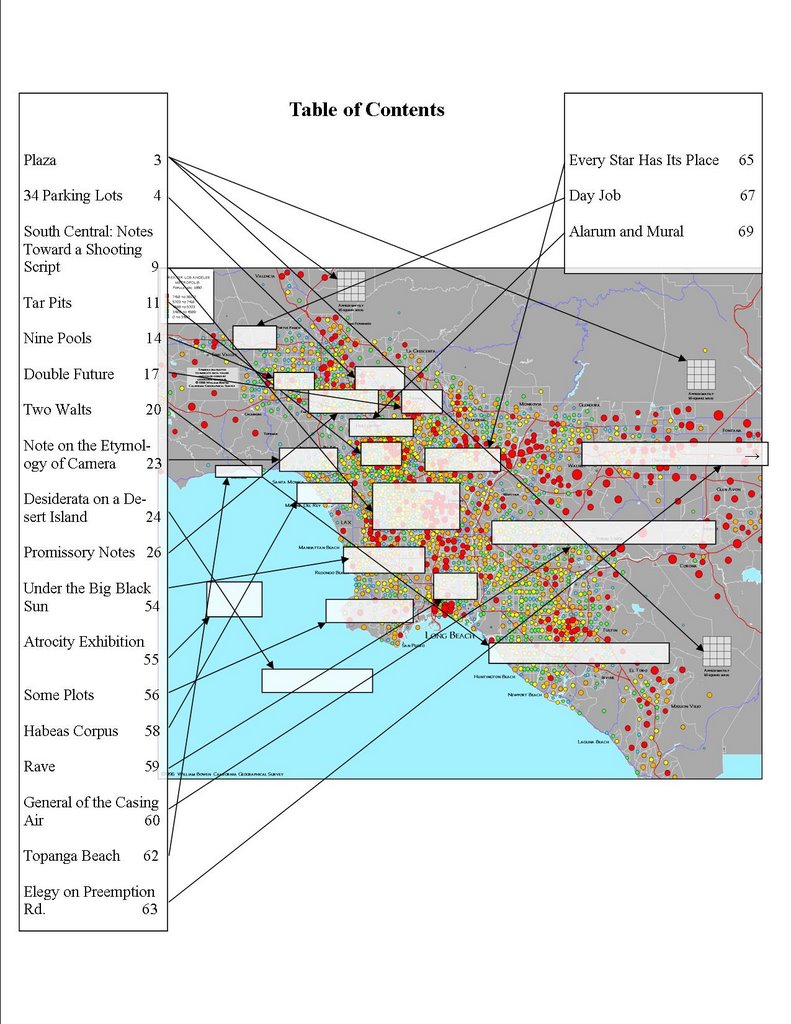
open cover letter
Toward a Pornography of the Sublime is a collection of poems about—but also “of” and “to” and “from” and “for”--
Tuesday, March 28, 2006
And this . . .
SPD SPRING OPEN HOUSE
Saturday April 1st
12 Noon-4 PM * 20-50% off all books!
30% student discount
Readings at 2 PM * Music at 12:30 and 3 PM
Robert Hass, former Poet Laureate of the US, teaches at UC Berkeley.
Etel Adnan, Lebanese American poet and painter, will read from In the Heart of the Heart of Another Country.
Aaron Shurin, author of Involuntary Lyrics, co-directs the MFA in Writing Program at USF.
David Larsen is author of The Thorn and co-curator of the New Yipes series in Oakland.
Geraldine Kim’s first book, Povel, won Fence Book’s 2005 Modern Poets Series.
Steve Orth is the band Shivshark. They write story telling songs with no choruses or guitar solos and sing them to people, young and old.
At Small Press Distribution
1341 7th St. (off Gilman), Berkeley
updates
Down in LA over the weekend, with Anna and Noah, I caught the Courbet landscape show at the Getty's hyper-classical mountaintop purgatory. So much of the energy in those paintings--that wind which seems to pick you up and plant you inside the painting--comes from the decisive placement here and there of patches where the grain of the canvas shows through. What's that in poetry? Grammar, letters, stuttering.
________
Two from Noah:
"Stop talking to mommy. It hurts my ears."
And then, playing with his imaginary watch (a rubber band), he says , "I need a bandaid on it."
He should be grateful, I tell him. Some of us need a tourniquet.
____________________
One of the great pleasures of Blog-o-ville has been watching Josh think through and work out his dissertation--starting with what seemed, originally, a difficult and super-specific idea, and turning it into something that has been invaluable to me in understanding the current moment in N. American poetry and its antecedents--a moment that, with its confluence of coasts west, east and internal, romanticism and modernism, visionary-poetry and deconstruction, seems to find its analogue in European philosophy's turn toward ethics, politics and the theological. I haven't worked out what this means exactly--or how I feel about affirmation, construction or mythology in an age that seems to need the destructive as much as any, even if construction and destruction, in the best poets, seem two side-effects of the same motion. I see this in Lisa Robertson, in Josh's own poems, in Juliana Spahr, in Joshua Clover, in Anne Boyer and, in general, in much but not all of the poetry that moves me these days, moves me out of days and out of work, too. Less of a turn, then, than an addition to the continuing negational-critical project of things like Flarf.
Lately, I've been trying to learn to avoid a general impatience with groundwork and a general desire to overreach, to get to The Point--so I'll admit, for now, that my sense of all the history here is perhaps not clear enough for me to really map out what's happening. Is this just an extension of Modernist mythography? My suspicion is that the answer is no, but I'm still a ways off from that no.
I'll save my overreaching for the poems, where it's fun and where nobody (well, most body) cares.
__________
What's up with Charles Valle's editor's note in the new Fence? It's going to take more than name-checking (or, perhaps, mike-checking) Althusser and Benedict Anderson to make the last cover into an attempt to "question the reproduction of the relations of production." I didn't see any question there at all. Just a dull descriptive sentence--a crass attempt to link Fence to some vaguely edgy indie-rock eroticism, in hopes that the readers of Nylon might pull it off the shelf and find it impossible to relinquish. Any stoner with a pair of scissors and a gluestick could do better. Nevertheless, I always find good reading in Fence.
---------------------
32 years old today. Huh.
Wednesday, March 15, 2006
What I think: political and aesthetic sense.
What you think: marketing, hype.
If there's a political unconscious, it's over there, where the posers and hypocrites play.
Tuesday, March 14, 2006
Monday, March 13, 2006
Looking, Reading
If you want to read about Joshua Clover’s The Totality for Kids, scroll down
Poets looking for proof of their utility to the rest of the world might be cheered by considering the effect of their absence upon Thomas Hirschhorn’s installation, Utopia, Utopia = One World, One War, One Army, One Dress at California College of the Arts’ Wattis Insitute. Ugly to the ughth degree, Hirschhorn’s maze of camouflage and theoretical afflatus, replete with don’t-eat-the-brown-acid art-school touches like dissembled mannequins and toy soldiers, is occasionally ugly in a profound and moving manner. One wall features shelf after shelf of globes from which camouflage excrescences bulge; on one wall-map camouflage has, à la The Blob or a nanotech “Grey Goo” apocalypse, taken over North and South America. The mannequins, too, seem afflicted by this cancer, hemorrhaging camouflage from their skulls or torsos. But the most grating and, in the end, suffocating aspect of this installation, is the text—an essay by the erstwhile philosopher Marcus Steinweg—that Hirschhorn has cut and pasted in fonts of various sizes and in fragments designed, it seems, to empty the language of all but a few crumbs of intelligibility. Différance and cogito and uebermensch and, um, fragments of sentences about Deleuze and Lacan and Badiou and Agamben and Scooby Doo, no Kristeva or Cixous or Judith Butler of course. These are all thinkers, mind you, who I read and think about and take seriously enough to dislike the ways in which they have been reduced to, well, a fashion, a gesture, flourish, a screen or camouflage for who-knows-what velleities utopian or dystopian or both. It makes one scared of the invisible and subterranean complicities that might underlie the work I take seriously and believe in. For Derrida, one of the things that announces, as he says, “the death of the civilization of the book” and its metaphysical accompaniment, is an inflation and emptying out of language, “a convulsive proliferation of libraries”—the image of which, Hirschhorn has certainly given us.
Hirschhorn likes Deleuze—he’s designed monuments to the philosopher— and his show reminds me of an important distinction that I came across the other day when reading Deleuze, who has often been accused, by me even, of a kind of irresponsible glorification of insanity and naive primitivism which is unrealistic at best and dangerous at worst. What is to distinguish Deleuze’s “cosmic” deterritorializing, his liquidation of the individual, of the self, of relationship to place and memory and experience, from the operations of global capital? The following quote explains: “Sobriety, sobriety: that is the common prerequisite for the deterritorialization of matters, the molecularization of material, and the cosmicization of forces. Maybe a child can do that. But the sobriety involved is not necessarily the becoming of the child, quite the contrary; the becoming-mad involved is not necessarily the becoming of the madman, quite the contrary. . . Thus the problem of the artist is that the modern depopulation of the people results in an open earth, and by means of art, or by means to which art contributes. Instead of being bombarded from all sides in a limiting cosmos, the people and the earth must be like the vectors of a cosmos that carries the off; then the cosmos will be art.” In this, Hirschhorn might overshoot the mark, and produce an undifferentiated glop rather than vectors of escape.
Hirschhorn might have done to collaborate with, if not a different philosopher, then with a poet—poets being those who know the utopian genre, its temptations and dangers, so well. Joshua Clover’s long-awaited (here at least) The Totality for Kids also knows very well the pleasures of the textual. It’s one of the most citational books I can think of: the title of the book is a quote (from Raoul Vaneigem), the titles of the poems are often quotes, the poems themselves are filled with citations from Apollinaire and Benjamin and Marx and Joy Division and Lettrist and Situationist-texts, “filling / The April air with silver quotation marks,” “under the strict surveillance of quotation marks. . .” The most prevalent source authors here are Benjamin and the various writers of the Situationist International and its predecessor group, particularly the “Formulary for a New Urbanism” of Ivan Chtchetglov, of whom Guy Debord writes “he transformed cities and life merely by looking at them. In a single year he discovered enough material for a century of demands; the depths and mysteries of urban space were his conquest. . .” Chtchetglov, along with others, merits a number of excellent elegies in this book, elegies which are also eulogies and which cause the book to hover between the sense of potentialities lost and potentialities to come.
So, full as it is with the writing of writers, Totality is as much a book about cities, chiefly Paris, as it is a book about citations-- a book about books, a city of books and a book of cities. As Clover writes it, “a copy of the city in the library and another in the ether. Indeed, the cities-for-texts metaphor field is one this book’s most insistent tropes; you could replace city with poetry, or make a similar series of substitutions, and the essential drive of these poems would be about the same.
All in all, I’m wild about Totality; it has shown itself well worth the decade-long wait. Perhaps what I think is the most remarkable thing about this book is its insistent location in the sensorium—in colors, textures, sex, jokes, painkillers, friendship, music and fun and the commingling in the mind—all things the all-too-frequent abandonment of which by everyday life poetry can be measure of. At the same time, Totality refuses to ignore the provenance of these pleasures, their implication in a system of exploitation and misery: “beneath it the gear rooms of the calendar where tiny cracks have been discovered in every hour time has started to trickle staunched with grease and sweat a shudder a sadness at waking.” Joshua and his collaborators are smart enough and have spent enough time thinking about capital to know that there are qualitative differences in these kinds of sensual experiences—some that are part of the problem and some that are part of the solution and some that just are: “many systems to put those dreams there inside her amphitheatrical skull operated by people known as affect workers like you and me and Drew Barrymore. We help people feel certain ways and are paid a living wage plus the little bit extra called the hook or the sting—a small but pleasant feeling like tiny holographic version of meeting the president.”
What I’m getting at here is that this book, like much of my favorite poetry of the present moment, is visionary without being theological or without, that is, a loss of critical power. Here I’m referencing my other favorite Joshua’s schema of a week ago, where he attempted to distinguish between A-negativity and criticality/ B-romantic-expressionism and / C-romantic-visionary poetry. Although I think there’s usually one tendency that’s more apparent than the others, I think there has always been a good deal of poetry in which A and C are part of the same essential thrust—poetry that is decreative as much as it is visionary, and without any of the didacticism which might sometimew accompany such a project. Joshua’s book is one more fine addition to this tradition.
Sunday, March 05, 2006
What I'm Reading
The Canary
A first turn through the pages of this magazine finds me among most entertaining aned engaging of accomplices and interlocutors. I’m about where Jordan was when he gave it his enthusiastic approval the first time around—and like Jordan I find the editors’ sensibilities consonant with mine. Jennifer Moxley’s poems, which open the journal, are rueful meditations on how quickly political engagement can turn to empty formalism; at the same time, these are also, it seems, a reflection on Moxley’s poetics, and they evince her obligation to a continued engagement with poetic (as well as political )form, if she is to maintain the integrity and intensity of disposition that readers have come to expect from her. The stunning last poem, surreal in the best sense of the term—an engagement with, rather than withdrawal, from the real—with its post-apocalyptic mall scene, seems to set up a image reservoir that the rest of the journal, oddly, keeps drawing from. Some kind of revenant keeps returning throughout these poems—in Alice Notley’s spare and broken and absence-haunted songs; in Raymond McDaniel’s Oulipo meets Hopkins meets Night of the Living Dead meets Mother Goose; in Gillian Conoley’s Frankenstein. No zombies in Moxley’s poem, but I’m reminded that malls and other places of public exchange are, of course, the sites of choice for undead hordes because there, within the regurgitated melodies and brand-lighting and must-have non-needs, they blend right in. This makes The Canary less the kind that sings kindly by the window than the kind you take into the coal-mine. It’s also a nice object—the not-quite-sky-blue, artless cover lets us look through to the contents, and I find the font and the not-quite-square size of the thing particularly satisfying: where too big meets too small, where things do not equal themselves, yep, there’s poetry.
There are lots of other poems that deserve mention—Brenda Shaughnessy, Philip Jenks, Anne Boyer (we love you! come out of the barn and publish your book!) and Joshua Clover, whose sublime The Totality for Kids just arrived. I need a couple of days to think on this book before I can say a few words about it. Do get a copy, though.
++++___________________________________________++++
Pretty Young Thing (Danielle Pafunda)
Someone should write an article about poets like Danielle, Heidi Lynn Staples and Lara Glenum, among others, who it seems are working hard to reanimate/ disinter the seemingly decomposed (and not so exquisite) corpse of surrealism and the powers of negation it offers us in this particular damaged and damaging time. Danielle’s book reminds me of Lara’s (which I reviewed here) to a certain degree: they have a milieu in common (places called Body and Non-Body)—but the poems in PYT don’t use the narrative or topical frames that one finds in Hounds of No. Danielle’s book truly goes on its nerve, pushing forward, Beckett-like, by a thread of texture or by dint of poetic will and desire. The long poems in this book are particularly good, continuously generating and then displacing narratives as they go—here a wedding, an operation, subjectivity, sex, here womanhood in all its intellectual and biological armature. One can hear, to a certain sense, the riddling and riddled textures of Berryman’s Dream Songs and Dickinson’s best poems. Indeed, you could probably make the case that the form of these poems is, in many cases, an example of the seven-beat line which some prosodists have found occasion to think of as a kind of ballad meter (two lines for the price of one):
When I got out in the weather, the weather was missing. The hour
slit like an electric cord, splintered, and fused to the pavement.
There was a space in the road where I thought a handsome cab should be.
There was really a space, and you would’ve been here to fill it.
Not incidentally, that handsome cab does appear in the final line of the book. But it’s on fire:
At the end of Oklahoma, only the haystack was burning. The surrey.
++++_________________________________________________________++++
Last but not least, I wanted to mention that those of who are in New York early next week should go see Ben Lerner read at the Poetry Project on Monday, Mar. 13 (8:00 p.m). Ben’s Angle of Yaw (out from Copper Canyon late this year, or early next year) was one of the highlights of my 2005 reading season. You can find a chunk from the book in the recent Conjunctions. There’s a fierce directness and clarity and license to Ben’s poems. As well as anyone, Ben gets the feeling of the present moment—its vertigo, its floating blidnesses, its perversities—right.
Thursday, March 02, 2006
Sunday, February 26, 2006
Happy to hear that Pavement Saw is going to bring out Josh's chapbook Composition Marble (f.k.a. "Kiosk/Stylus"). It's a truly exquisite poem, and I hope that many people order copies. Definitely my favorite piece of writing by one of my favorite writers.
Monday, February 20, 2006

Thursday, February 16, 2006
R.I.P. Barbara Guest
The Minus Ones
She submitted a few stories she called The Minus Ones.
They came to her as short signals, as if they lived on her roof top. They rolled off the roof of her mouth climbed there from memory or from a table where empty cups glistened with tearfulness. Also menu-like out of her stung heart came surprising plots: Spanish women and high shoes, stories of valleys and boatless seas no cargoes. Rocks similar to the porpoises in her marine story appeared. They were made of coal hard yet they chipped flakes of coal dust blew off them soiling her clothes.
From her reading she borrowed a lake bottomless and a body without gravity flying over it. This appropriation brought on a serious malaise; she became plotless and her stories were bound without the usual wrapping of ribbon.
Seasons became important, ivy on green trees and the mournful rhododendron, icicles appeared more frequently. And meadows with horses. She neglected to include the rituals of contemporary life and the Scenario Department complained. When she wrote of wood burning she said the devils inside the fire were excited.
The fire scene destroyed any chance she had for her new stories to be accepted. They told her they liked real fires and not those of the imagination. Imagination was harmful and always messed up the set.
--from The Confetti Trees
Wednesday, February 15, 2006
What's a Poet?
I agree that the tendency to construct a person out of words, and to interpolate into these words whatever we know about a poet--Josh plays D and D, Jordan likes Anime, some of us are parents, some aren't--is probably to some degree inevitable, and indeed I don't think there's anything wrong with this kind of reading practice, as long as it's one practice among many.
But there's a big difference between missing the words for the poet, looking past the page to the life, and seeing the poet as words, as an authorial intention emanating not from an apartment in D.C. or Oakland but from the particular arrangement of verbal references language allows. So much of the poetry that I value frustrates any other kind of experience. And although I know that the part of me that seeks to predict the behavior of others will always construct some kind of intention, there is poetry that reminds me of what a fictional intention this is--and thank god.
I'm very sympathetic to the desire to recuperate terms like personality and sensibility for poetry criticism. But, for me, it's important to know what I'm talking about.
"What makes my image of him into an image of him. Not its looking like him!"
Otherwise, aren't we just playing Oprahs to The Tiny's Freys and James? As Jane reminded us awhile back--a comment that Ron reiterated--most of the cultural forms with "wide circulation" love the idea of poetry, the idea of the poet, the life of the poet, but they don't want to do the hard work of actually reading a poem.
And this is one of the ways Kasey's category 2 turns into category 1. This is the way we start working for Sales rather than R&D.
Thursday, February 09, 2006
Oh yeah, and on the subject of Legislating Danger I was just talking to someone yesterday who pleaded with the editors (in many e-mails, apparently) to change the title, or at least the subtitle. But they wouldn't budge. And so he refused to put his poems in. Wasn't the only one either, I guess.
Being clueless to how things might read is one thing. I'm sure I'm guilty of this from time to time. But having it explained to you and then insisting on remaining oblivious, well, that's another thing altogether. They probably could've taken a simple poll. Does this sound creepy and Orwellian or just plain bad?45 out of 50 poets choose yes.
Kasey gets to have all the fun . . .
My double-header tomorrow is Helene Cixous in the morning and Bernadette Mayer at night. Not quite SWAT Teams and Vagina Monologues, but hey. . .
On the subject of the absurd, I was sort of hoping that somebody besides Tony would provide a general rebuttal of the Hoy piece in Jacket, but I guess its asininity was fairly transparent, and fairly clearly not worth the effort.
A more nuanced, astute and less ad hominem consideration of the technologization of the poetry world--and the changes (good, bad, indifferent) it might augur is worth asking for. But I don't think Hoi Polloi's our guy. It's hard to not detect the smell of vendetta on his keyboard stomp-dancing. It seemed pretty, well, lame that someone who takes such obvious pains to carefully and level-headedly explain where he stands--agree with it or not--should be the target of a basically personal attack.
I certainly don't have any doubts that it's only a matter of time before Google calls in its loans--you, me, everyone. But by that time, man, it might be either too late or too early. Anne Boyer will have let the squirrels loose. . . There might not be any way to get them back into their cages. Don't Be Evil? OK: Don't Be a Publicly Traded Corporation.
Thursday, February 02, 2006
Be as I may a subsidiary and fleshly annex of Eli Lilly, Pfizer, Google and Microsoft, "addicted to oil," I aver now that the poetry of mild comfort doesn't stand a chance against the wonder trio of Kasey, Anne and Steve Evans.
It's worth adding that, of course, all those travelers reaching into the bedside table for a copy of the tedious verselets in Poetry magazine will be depressed more quickly than you can say "biopower twins activate." And the dollars spill back into Eli-Lilly.
Monday, January 30, 2006
Andrews Elmo Parker Shapiro
Bruce Andrews gave a devastating reading last night for David Larsen's New Yipes! reading series, in the concrete and drywall space of endless possibility that is 21 Grand. I can't remember the last time I laughed so hard and with such abandon, or had such a clear sense of the violence upon which so much belly-humor depends. Stopping then, and thinking, not so funny.
Andrews read his poems with an expressive variety and a sense to the value of pauses and tempo changes that I wish more poets would learn from; you could really hear the prose form as a series of grammatical constraints: a set of sentence-forms wherein his avalanche of mixed categories (mixed metaphors, as I meta- here) click into place. I do wish that I got more of a sense of this when I read Andrews on the page, as much as I realize that the all-at-onceness and the brutality of the prose is part of its work. I suspect, though, that now when I turn to read Andrews I'll have a different, and much improved, experience of it. Perhaps, to some degree, the extension and success (or, to some I'm sure, the diminution) of writers like Kasey and Bill Luoma and Kevin Davies is that they bring this kind of variety to the page, and with it a wider range of possible gestures, swerves and gear-shifts.
Perhaps a year ago, Jonathan Mayhew made the remark that Bruce Andrews reminded him of hip-hop, for which comment, as I remember, he was castigated by bloggers various and sundry. Although I see how this is a deeply problematic comparison, I think that what Jonathan was picking up on was the common influence of beat poetry on both forms --those noun paintings and register collisions that you hear in performance poetry today, and which eighties and early-nineties hip hop to some degree resembled. Perhaps the historical argument is shaky, and the common denominator is only an apprent one. Obviously, lots of other influences (vernacular traditions, etc.) that the two don't share, but there was something to Jonathan's comment nonetheless. . .
_____________________________
In other news, it appears our children's toys are in favor of euthanasia. Possible subtitles: paging Melanie Klein; or, revenge of the commodity--potty training = want not equaling need; excess here, privation there (with all apologies to those bloggers/readers who are in the process of potty training their children). The revolution will be really cute.
__________________
Saw the Cornelia Parker installation at the Good Herb center--beautiful and eery, certainly, but how much anti-work a bad pun for a title can do. A word is worth at least a thousand pixels in this instance, or else a superficial politics poorly hung. I sort of wanted the one church in front of the other--a seeing-through rather than a seeing-next-to. And why so cubic? I'm still trying to figure that out.
But Noah was so happy to go on the carousel. He rode the goat. All goats lead to roses.
___
Reading a David Shapiro book for the first time ever (A Burning Interior). What a thrill!
Tuesday, January 24, 2006
Apologies to those who feel I missed the subtlety of their poems. "About" is always a bad preposition for poetry, implying as it does a distinction between content and form, subject matter and presentation that often doesn't hold. In English, propositions are like the streets of D.C. or Boston or an awkward simile. . . There should be (but ain't) a quicker, more direct way to get where you want to go. I would, however, have to be a deep literalist of the body to miss the sex--metaphorical or not--in those poems. It doesn't really require any exegetical jujitsu to extract. It's not like I'm saying that walking up a staircase (as Freud does) resembles sex in that it involves repetitive motion with an eventual endpoint. Nor am I playing a dull round of find-the-privates.
Of course, I agree that the way the anthology was described by Reb, as well as the way the preface and the cover frame the poems in it, colors my reading. I was responding to the anthology as an object, as poems in a specific context. I would assume that most people, like me, don't believe that the poem is some kind of stable unchanging object capable of resisting whatever context might impinge upon them. . . Maybe certain poems can do that to a certain degree, but not these ones. And this is not like a remark about quality; I like all the poems to which I referred. . .
Monday, January 23, 2006
Bedside Anthology
Since receiving it, I have wanted to write about, and recommend, Reb Livingston and Molly Arden's provocative anthology The Bedside Guide to No Tell Motel--even though I haven't had the time to read all of the poems in it.
It's an anthology full of fantastic work, as those of you who regularly read No Tell Motel already know. But I also find it disturbing--as an anthology about sex in the present moment in American culture, it leaves a somewhat troubling afterimage in my mind. It makes me feel that sex as a meaningful aspect of bodily life is in trouble, as all things interpersonal are in trouble. If this anthology presents, between its pages, a safe harbor for the erotic, a place where one's needs and desires will not be betrayed, it is one so threatened by isolation, non-communication and indirection, that most of the fucking/lovemaking/intercourse, etc. in this anthology fails. Maybe sex, as a nodal point where social power is both performed--(assume the position)--and subverted( (_________)-style), has always been this way. But somehow I suspect that the quintupling of porn consumption (and I am all for porn, I have no qualms about it) tells us something. Between the Paxil/Prozac/Zoloft holy-trinity and the adult film industry, I somehow feel that Americans (for all our professed liberatedness about sex) have more sexual hangups than fin-de-siecle Viennese. When everything is sexualized, when sex is, as Shanna Compton's poem has it, just a font advertisers use to sell products, just something you can have added to your latte for thirty-five cents, you get sex like the Johnny in Anne Boyer's poem imagines it: "His popular mechanics lacked imagery." One wonders, have we gone from "Having a Coke with You" to "Having a Coke with Coke"? I've often felt that the supposed liberation of sexuality of the so-called "sexual revolution" had, as one of its untoward consequencs, the diffusion and, as such, liquidation of sexuality. Sex, then: everywhere and nowhere. Or maybe this is just parenthood talking. Maybe people aren't really more afraid to flirt; maybe I'm just becoming gradually less attractive.
I'm not an expert in these matters (an amateur, certainly), and I don't pretend to have fully thought through what this means. As such, I'll refrain from concluding that all of this signals the end of the human, of history, the body. Thoughts?
Subscribe to:
Posts (Atom)